Alibaba's Amap upgrades embodied AI robot system
Alibaba's location-based services platform, Amap, has released a full-stack upgrade to its ABot embodied AI system, enhancing robots' ability to perceive, reason, and act in physical environments.
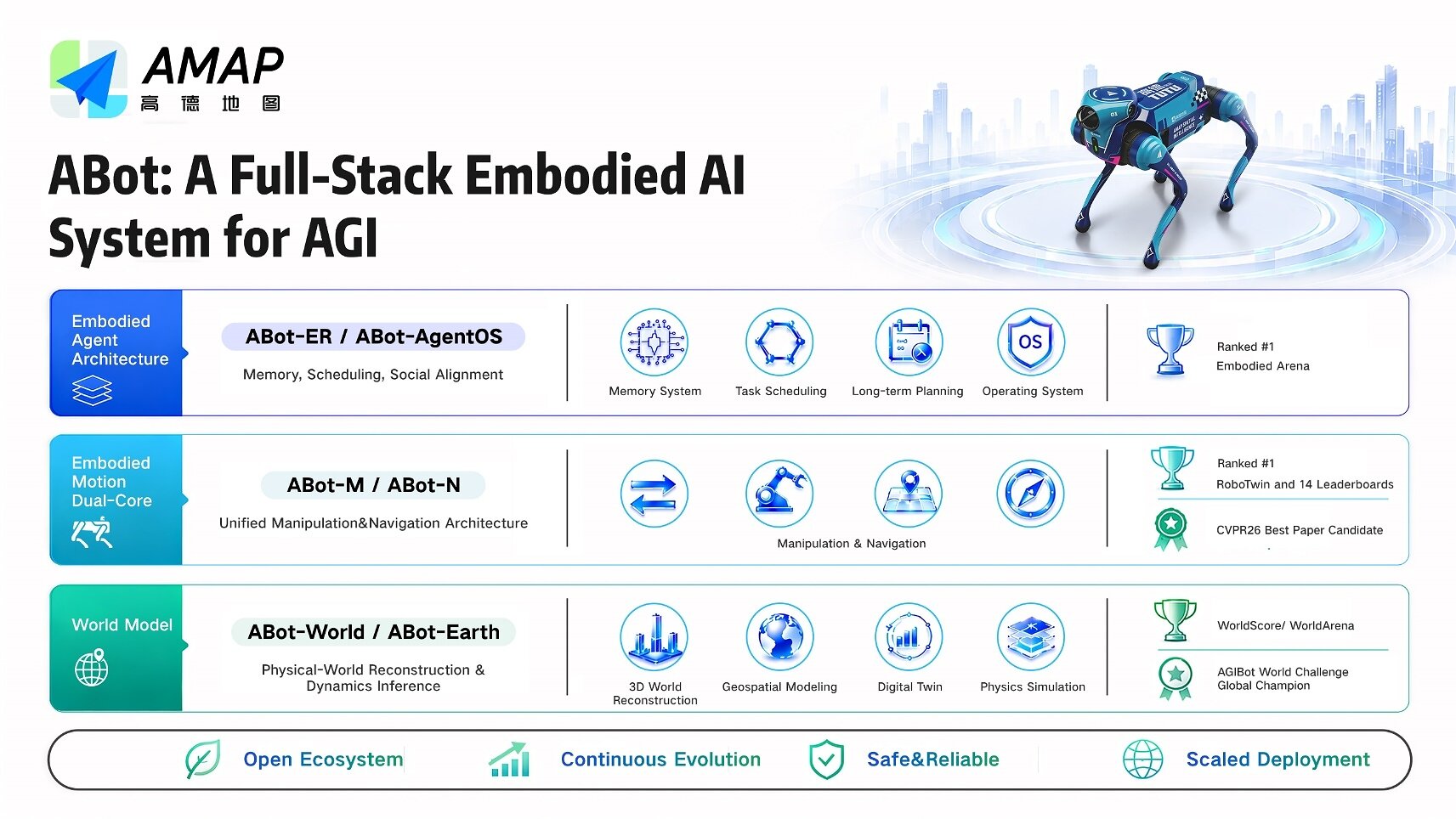
Beijing, China – July 22, 2026 – Amap, Alibaba's location-based services platform, has unveiled a comprehensive upgrade to its ABot embodied AI system. The new components, including ABot-N1, ABot-M0.5, ABot-ER, ABot-AgentOS, and ABot-C0, are designed to address key bottlenecks in robotics, improving robots' capacity to navigate, manipulate objects, and perform tasks in physical settings.
The upgrade aims to refine robots' navigation, manipulation, task reasoning, long-term memory, and motion control. According to Amap, the system achieved state-of-the-art results on 17 widely used benchmarks. The revised ABot architecture integrates world models, foundation models, and an embodied agent framework, allowing continuous improvement through feedback from simulation training, physical interaction, and memory management.
ABot-N1 focuses on robot navigation in open environments. It employs a dual-system architecture where a slower module handles long-range reasoning and a faster module manages real-time control. ABot-N1 can perform city-scale autonomous navigation using only maps, achieving a 92.9% success rate in outdoor navigation tests.
ABot-M0.5 is designed for robot locomotion and object manipulation in complex, multi-step tasks. It separates movement and manipulation into distinct action streams and utilizes a "dream self-healing" training method to minimize errors from minor deviations. In RoboCasa-365 tests, ABot-M0.5 surpassed previous state-of-the-art performance by 20.4% on complex tasks and 10.6% on basic tasks.
ABot-ER and ABot-AgentOS constitute the embodied agent layer, supporting decision-making from perception to action and converting task experiences into long-term memory. ABot-C0 translates the system's decisions into physical actions. Research papers detailing the system's components have been published on arXiv.