Asteroid impacts melted early Earth's crust, forming continents, study suggests
A new study proposes that Earth's first continental crust formed due to intense asteroid bombardment around four billion years ago.
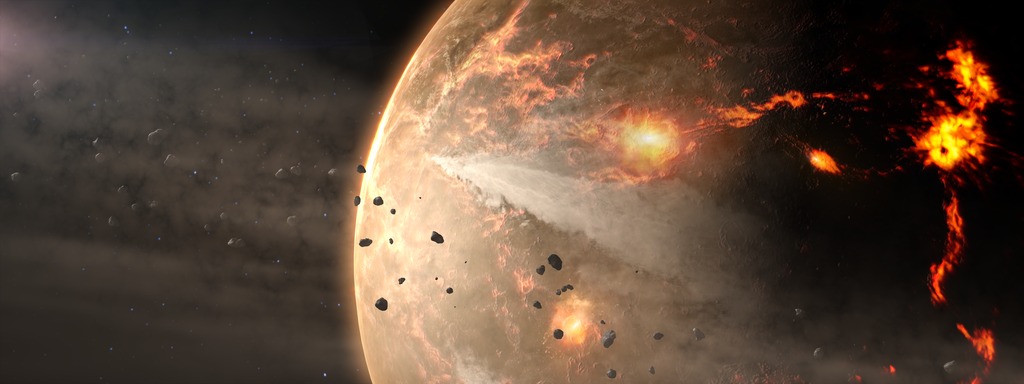
Earth's early continental crust may have formed from sustained, intense asteroid impacts that kept the nascent crust hot and thin enough to allow for the formation of buoyant continents, according to new research reported by Ars Technica. The findings suggest that the lands we live on are a result of ancient extraterrestrial bombardment.
"The continents started appearing around about four billion years ago—that's the oldest continental rock we know about," said Tim Johnson, a geologist at Curtin University, explaining the puzzle of why continents emerged so long after Earth's formation 4.5 billion years ago. The exact mechanism has remained a significant debate among geologists due to scarce evidence from that period.
Geological evidence from Earth's earliest history, particularly the Hadean eon (the first 500 million years), is extremely limited. The oldest known continental-type rocks date to about 4.03 billion years, with some zircon crystals pushing the record back to 4.4 billion years. This scarcity has forced scientists to rely heavily on hypotheses and modeling.
The proposed impact theory suggests that the continuous barrage of asteroids maintained the early Earth's crust in a molten or partially molten state. This would have facilitated the accumulation of lighter, silica-rich materials that rose through the denser basaltic oceanic crust, ultimately forming the first continental masses. This process provides a potential explanation for the origin of continents roughly 500 million years after our planet's birth.