China vs. US: Physical AI Competition in 2026
Cervicorn Consulting compares China and the US on physical AI in 2026, examining robotics, investment, and policy.
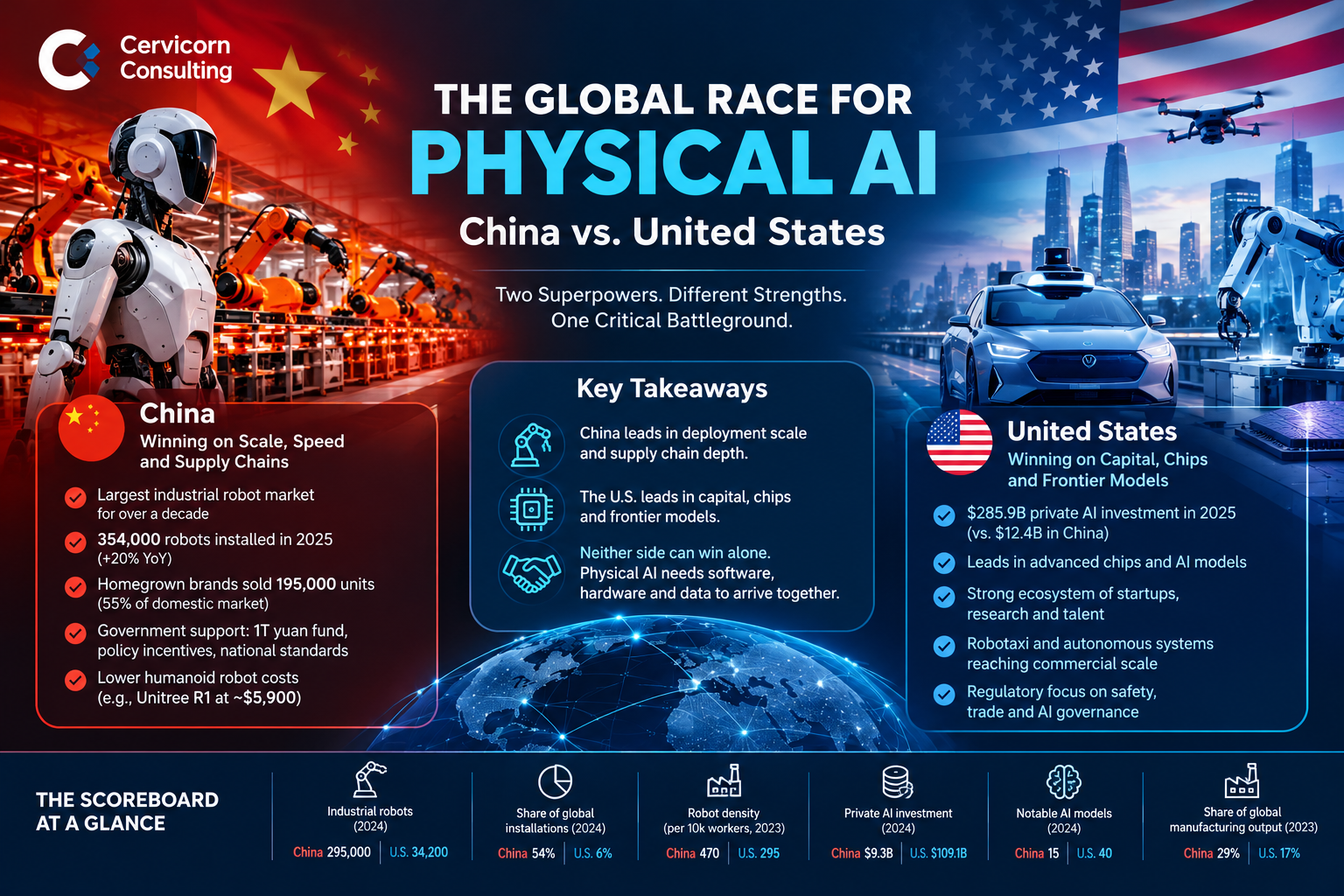
Cervicorn Consulting's 2026 analysis positions China and the United States in direct competition within physical AI, which encompasses intelligent machines operating in the real world, such as robots and autonomous vehicles. Unlike software-based AI, leadership in physical AI is harder to displace once established, requiring physical components, manufacturing facilities, and real-world operational data.
China leads significantly in industrial robot deployment, installing approximately 295,000 robots in 2024, accounting for 54% of the global total, while the US deployed 34,200 units. China's advantages lie in its scale, efficient supply chains, and higher robot density per worker. The country also benefits from its substantial share of global manufacturing output.
The United States, conversely, attracted considerably more private AI investment in 2024, totaling $109.1 billion compared to China's $9.3 billion. US strengths are in capital access, advanced semiconductors, and cutting-edge AI models. The US also released more notable AI models during the year, with 40 compared to China's 15.
The report indicates that neither country can achieve victory alone in the physical AI race. Success demands the effective integration of software, hardware, and data, making the competition complex and interdependent.