China's Automotive Strategy Reshapes Global Competition, Report Finds
A new report forecasts Chinese-origin brands could capture nearly 20% of Europe's light-vehicle market by 2030, highlighting the industry's large-scale competitive realignment.
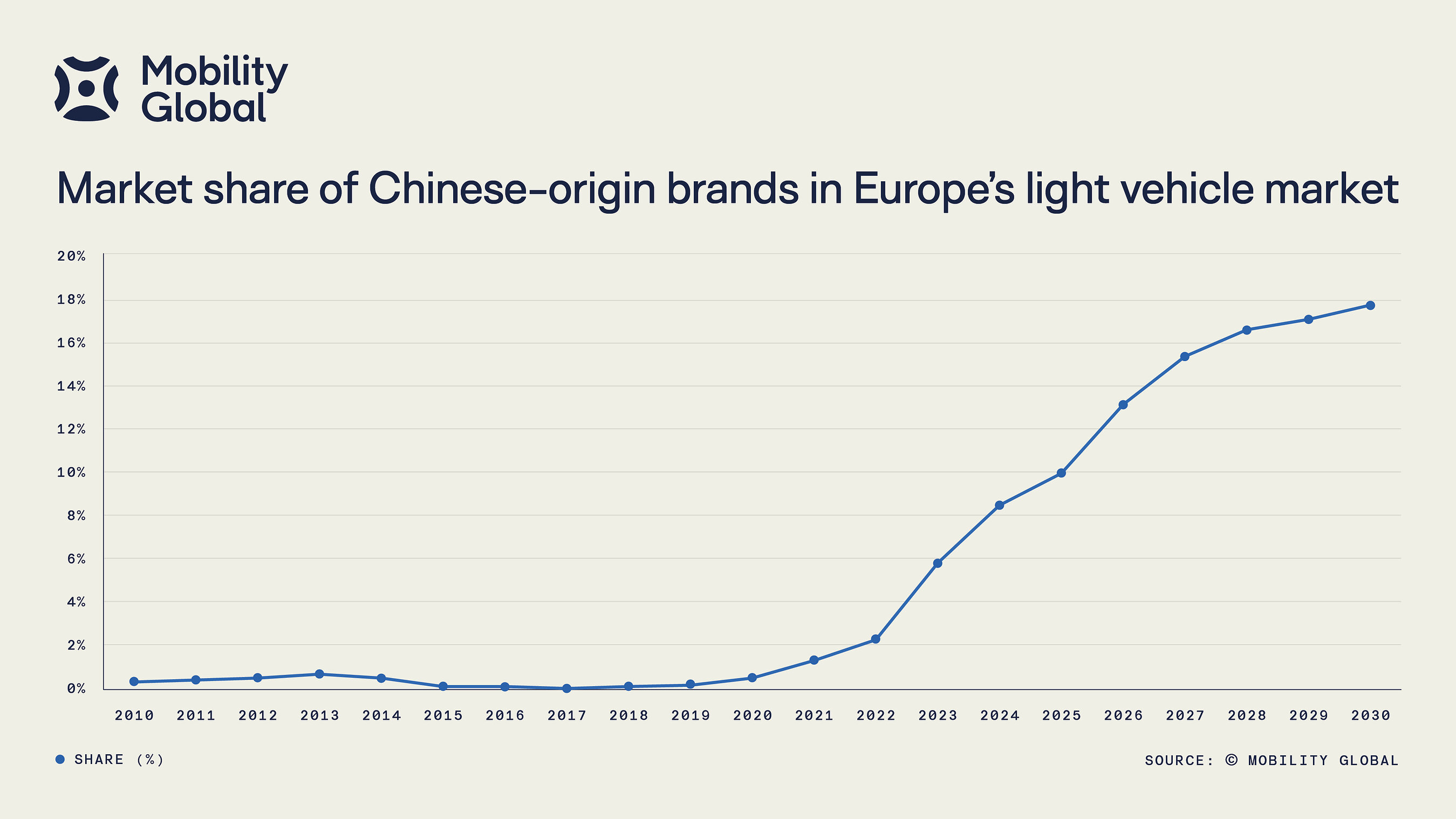
A new report indicates that China's strategic approach to its automotive sector is fundamentally altering global competition. According to "New Order: China, the West, and the Battle for Automotive Advantage" by consultancy Mobility Global, success in the industry is shifting from vehicle technology alone to the effective orchestration of entire industrial systems.
The analysis projects that brands originating from China could secure close to 20 percent of the European light-vehicle market by 2030. Concurrently, foreign automakers' share in the Chinese market is expected to significantly diminish. This shift reflects China's decades-long deliberate focus on developing its automotive industry as a national strategic priority.
"The bigger story in the industry isn't electrification, but a restructuring of the competitive landscape itself," stated Michael Robinet, vice president of forecast strategy at Mobility Global. He emphasizes that future success will belong to companies adept at reducing complexity, accelerating decision-making, and fostering adaptive organizations, focusing on building a superior system rather than just superior vehicles.
The report outlines two potential trajectories for Western automakers: a "Western Renaissance" scenario, involving substantial structural improvements, or a "Managed Retreat" scenario, where competitiveness cannot be sustained across all market segments. Future success will hinge on structural reforms, including streamlining operations, consolidating architectures, and concentrating on core competencies, such as supply chains and software development.
Governments are also set to play an increasingly visible role. The report cautions that protectionist measures, like tariffs, may only provide temporary relief unless coupled with concurrent investments in industrial capacity, workforce development, and critical materials. North America faces a key tension, where regulatory policies could either accelerate reforms or prompt manufacturers to retreat into more profitable niches.