Creality Compares FDM and MJF 3D Printing for Part Production
Shenzhen Creality 3D Technology Co., Ltd. clarifies the differences and applications of FDM and MJF 3D printing processes. The choice depends on part requirements like size, strength, and production volume.
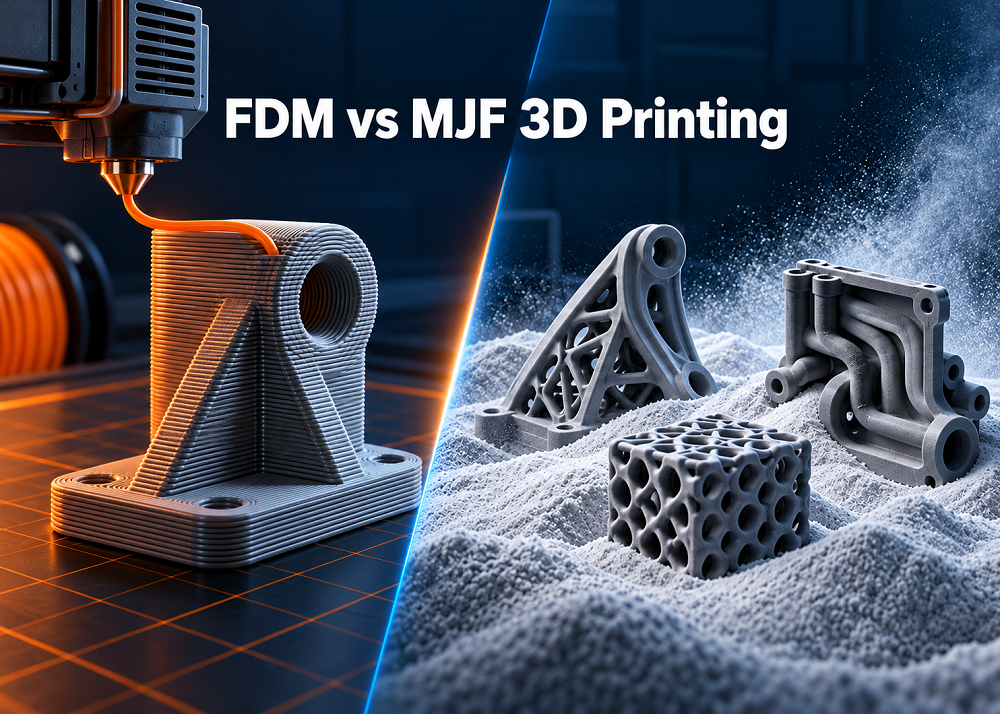
Chinese 3D printer manufacturer Shenzhen Creality 3D Technology Co., Ltd. has released a guide comparing two common 3D printing technologies: FDM (Fused Deposition Modeling) and MJF (Multi-Jet Fusion). The comparison aims to help customers choose the most suitable method for their part production needs.
FDM printing, which extrudes melted plastic filament layer by layer, is generally better suited for in-house prototypes, large parts, fixtures, and low-volume runs. This process offers users direct control over orientation, materials, and iteration speed on their own machinery.
MJF printing, which utilizes powder bed fusion, is more appropriate for complex, nylon-based parts that do not require support structures. Its advantage lies in dense packing capabilities, allowing multiple parts to be printed simultaneously without additional supports, making it efficient for production batches.
The choice between FDM and MJF largely depends on the volume, geometry, strength requirements, and timeline of the part to be printed. FDM parts typically have weaker layer adhesion compared to MJF parts, which offer more uniform strength across different directions. MJF also enables more complex geometries, such as internal channels, without the need for separate support structures that FDM often requires.