Data Center Battery Storage Grows Amidst AI Power Demand
The increasing power demand from artificial intelligence is driving the rise of Battery Energy Storage Systems (BESS) in data centers. These systems are transitioning from backup to a strategic necessity.
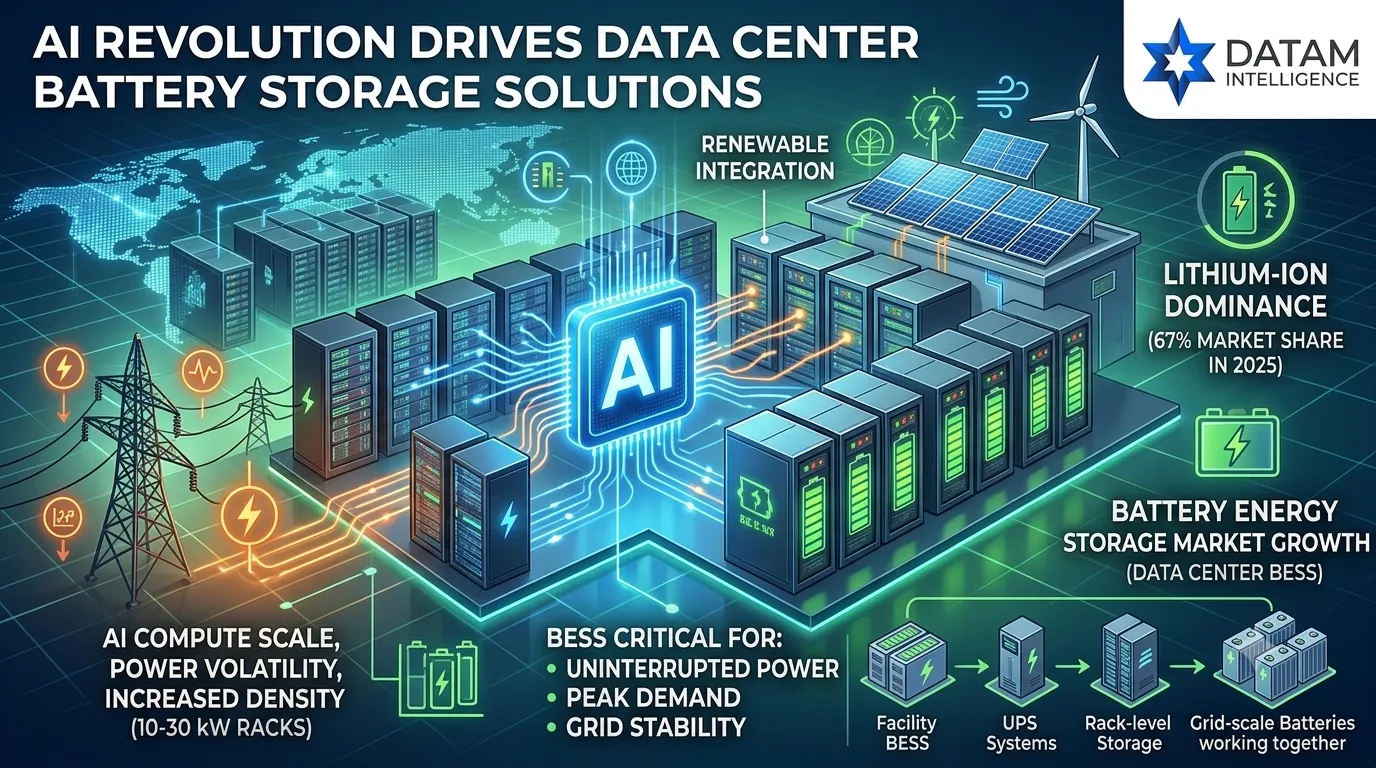
The global data center industry is facing a critical shift where power availability is becoming as vital as computing capacity. As artificial intelligence (AI), cloud computing, and hyperscale infrastructure drive unprecedented electricity demand, Battery Energy Storage Systems (BESS) are emerging as a strategic necessity rather than a mere backup solution.
According to DataM Intelligence analysis, the data center battery energy storage market is experiencing strong growth. This expansion is fueled by increasing AI workloads, significant investments in hyperscale data centers, greater integration of renewable energy sources, and a rising demand for uninterrupted power supply solutions. The market is also benefiting from the replacement of legacy battery technologies with advanced lithium-ion energy storage systems.
Historically, batteries served primarily as a short-duration backup power source in data centers, bridging the gap until diesel generators could activate during grid outages. However, the energy requirements of modern, AI-centric facilities have evolved. They now demand infrastructure capable of responding instantly to fluctuating workloads, maintaining uptime approaching 99.999%, supporting renewable energy integration, and managing escalating electricity costs.
AI workloads are fundamentally reshaping data center power consumption patterns. The training of large language models and the operation of GPU-intensive clusters create sudden spikes in power demand, necessitating highly responsive energy systems. A ZincFive report indicated that 57% of industry respondents cited increasing power density requirements driven by AI deployments, while rack power density continues its upward trend.