Distant Galaxy Images Reveal Hidden Dark Matter Concentration
Astronomers using gravitational lensing of a distant galaxy, HerS-3, have uncovered evidence of a significant concentration of dark matter. The findings, published in the Astrophysical Journal, relied on observations from multiple advanced telescopes.
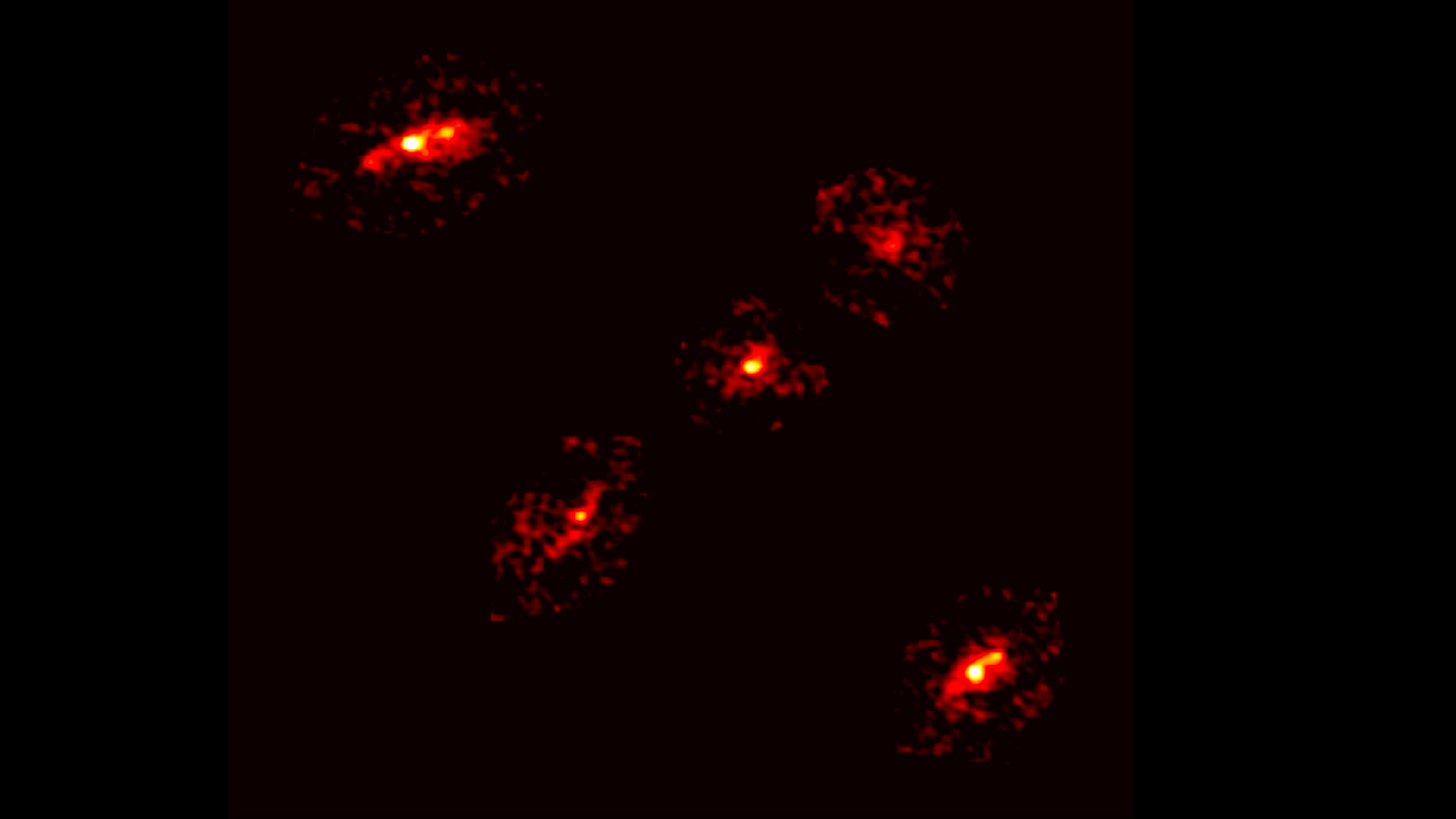
Chalmers University of Technology in Sweden, in collaboration with an international research team, has detected a substantial amount of dark matter using the gravitational lensing effect on a distant galaxy named HerS-3. The study, published in the Astrophysical Journal in September 2025, utilized detailed observations to map this invisible component of the universe.
The phenomenon of gravitational lensing occurs when the gravity of a massive object, such as a foreground galaxy cluster, bends the light from a more distant source. In this case, four massive galaxies in the foreground acted as a lens, distorting and magnifying the light from HerS-3 into five distinct images, forming what is known as an Einstein Cross. However, the researchers found that the visible galaxies alone could not account for the precise arrangement and distortion of these multiple images.
Modeling the lensing effect revealed that a significant, unseen component was necessary to accurately reproduce the observed images. This invisible structure, identified as a concentration of dark matter, is estimated to possess a mass equivalent to trillions of suns. Dark matter, thought to constitute about 80 percent of the universe's total mass, is undetectable by electromagnetic radiation but its gravitational influence can be measured.
The research involved combining data from several powerful telescopes, including the Northern Extended Millimeter Array (NOEMA), the Atacama Large Millimeter/submillimeter Array (ALMA), the Karl G. Jansky Very Large Array (VLA), and the Hubble Space Telescope. Chalmers astronomer Kirsty May Butler noted the rarity of such an observation and emphasized the critical role of interdisciplinary collaboration in astronomical discoveries.
This discovery provides crucial insights into the distribution of dark matter and its influence on the formation of large-scale cosmic structures. It reinforces the understanding that dark matter plays a fundamental role in shaping the universe as we observe it today.