Flash Stability: Color Consistency Essential for Product Photography
Color consistency in photographic flash equipment is crucial for professional product photography, ensuring uniformity across multiple shots and sessions.
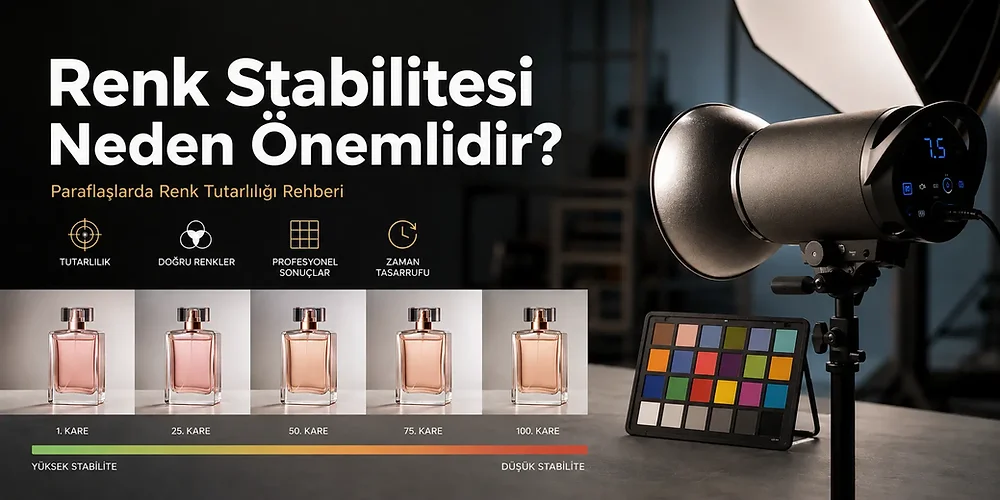
The color consistency of photographic flash equipment is a critical factor in professional product photography, according to Flaşçı. While the power of the equipment, measured in watt-seconds (Ws), is often the first technical specification considered, professionals increasingly value the gear's ability to maintain a consistent color output. Color stability ensures that different shots of the same product, or images taken across multiple shooting sessions, appear uniform.
Initially, photographers tend to focus on sheer light output, indicated by figures like 300 Ws, 500 Ws, or 1000 Ws. This provides an idea of how powerful the light can be and serves as a logical starting point for those setting up their first studio. However, as time in the studio increases and production volume grows, the perspective shifts. It becomes not just about how much light is produced, but how consistently it is produced.
These variations can be subtle in individual photos or even in a series taken on the same day. Problems become more apparent, however, when dealing with catalogs of hundreds of product images, photographing different color variations of a single product, or when a shooting project spans multiple days. Even if cameras, lenses, and light positions remain the same, minor color shifts can lead to some shots appearing warmer and others more neutral.
While Kelvin (K) values indicate the light's color temperature, they do not tell the whole story of color stability. Similar to a car's top speed, Kelvin represents a target value and does not guarantee consistent performance under all conditions. What truly matters is how similar the colors are between the first shot and the hundredth shot, which is vital for professionals producing large volumes of cohesive imagery.
Flaşçı points out that color deviations can stem from multiple factors, including the flash tube's construction, electronics, power management, and operating temperature. Especially during intensive use, equipment continuously produces energy and reaches a certain operating temperature. While some systems manage these variations successfully, others may gradually exhibit small color shifts over time. Although these deviations are often not dramatic, they can become significant in sensitive applications like product photography, leading to hours of post-production work to achieve uniformity.