Ford F-150: A History of Model Development
The Ford F-150, introduced in 1975, has a history rooted in the F-Series line launched in 1948. The pickup has undergone significant evolution since its inception.
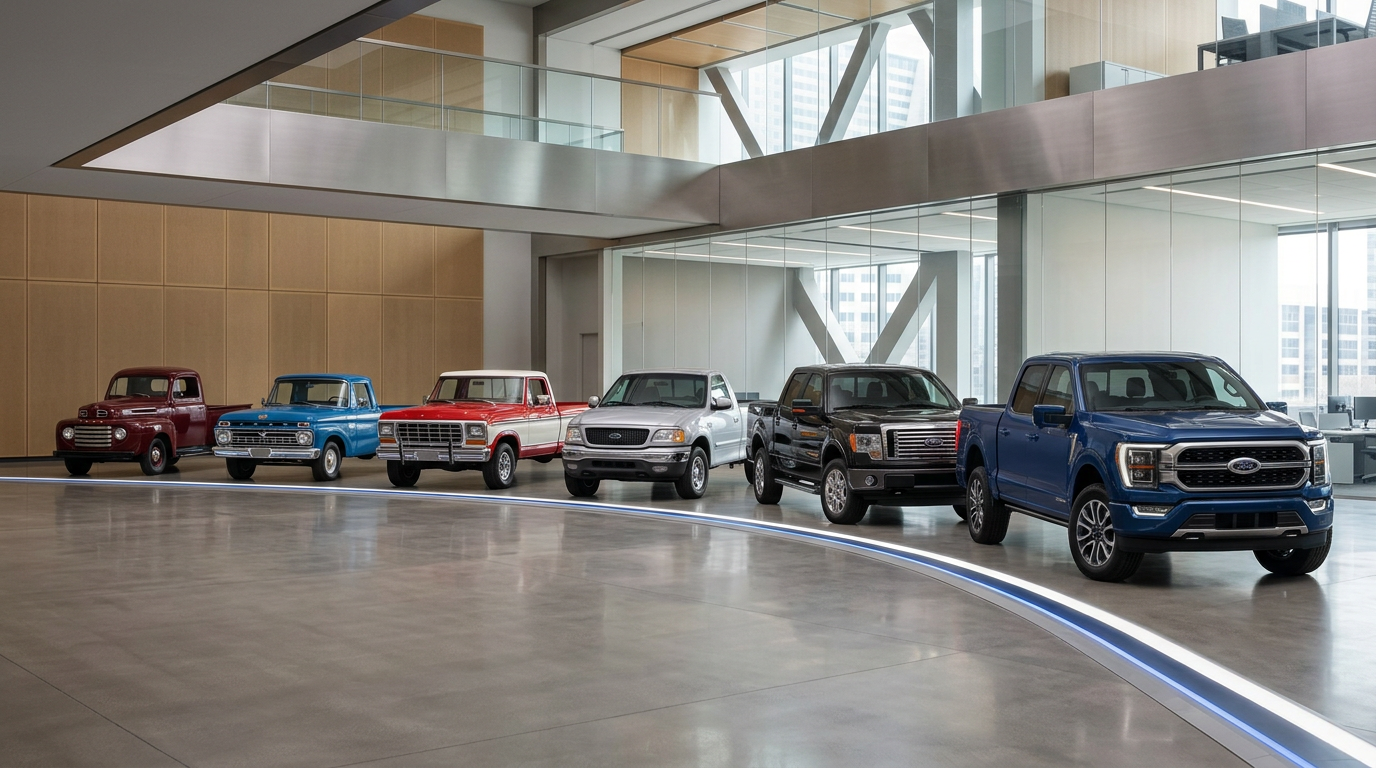
The development history of the Ford F-150 spans nearly five decades, beginning with its introduction in 1975. The model has undergone numerous redesigns that have shaped it into the vehicle it is today.
The F-150's story began in 1975 when Ford positioned it between the F-100 and F-250, offering higher payload capacity and complying with new emission regulations. While the F-150 name debuted then, its origins trace back further to the F-Series, launched in 1948 as the "Bonus-Built." This original line was the first to be built on a dedicated truck platform, with the F-1 serving as the predecessor to today's F-150.
The first major redesign occurred in 1980, introducing a new chassis, modernized body, and improved aerodynamics. By 1997, the F-150 underwent a significant transformation, adopting a rounded design and an SUV-like interior. This shift broadened its appeal beyond tradespeople to a wider audience, including families and city dwellers.
Throughout the 2000s, the F-150 continued its evolution. In 2004, it received a new platform, enhanced safety features, and improved comfort. The 2011 model year marked the introduction of EcoBoost technology, featuring a turbocharged V6 engine that delivered both power and fuel efficiency. A substantial change came in 2015 when Ford switched to a nearly all-aluminum body, significantly reducing the vehicle's weight.
Recent innovations in the model line have focused on electrification. In 2021, the F-150 PowerBoost Hybrid was launched, offering a full hybrid powertrain and the Pro Power Onboard feature, which transforms the truck into a mobile generator. The 2022 F-150 Lightning marked the arrival of an all-electric version, positioning Ford at the forefront of pickup electrification with features like a front trunk and bidirectional charging.