Four-Box Test Assesses AI's Impact on Jobs
A London Business School professor has developed a framework to help individuals understand how AI and automation may affect their specific job tasks.
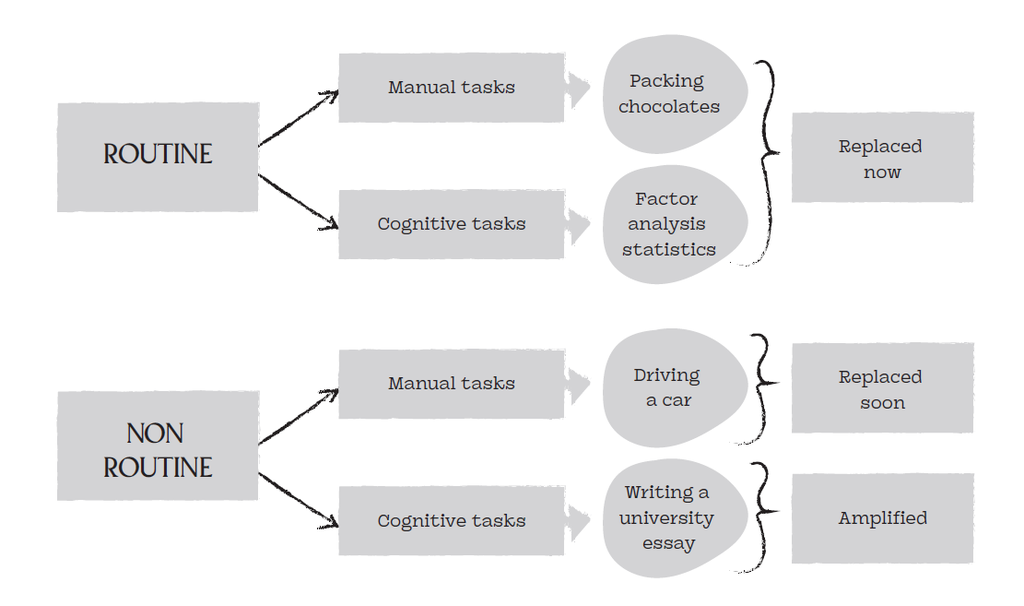
Professor Lynda Gratton of the London Business School has introduced a practical framework, dubbed the 'four-box test,' designed to help individuals assess the potential impact of artificial intelligence and automation on their work.
The core principle behind the test is that technology typically automates specific tasks rather than entire jobs. The method involves listing weekly tasks and then categorizing them based on two key dimensions: whether they are routine or nonroutine, and whether they are manual or cognitive.
The four resulting categories—routine/manual, routine/cognitive, nonroutine/manual, and nonroutine/cognitive—each indicate a different level of automation risk. Gratton notes that routine manual tasks, such as those in manufacturing assembly, have largely been automated. Similarly, routine cognitive tasks, like data processing, are increasingly handled by computers.
Nonroutine manual tasks, such as driving or plumbing, have proven more resistant to full automation due to factors like safety regulations and cost, although advancements in robotics are ongoing. The latest wave of automation, driven by large language models like ChatGPT, is now impacting nonroutine cognitive tasks, including writing, analysis, and even aspects of counseling.
Gratton's analysis prompts a critical question about what tasks will remain uniquely human in an increasingly automated world. The four-box test aims to equip workers with a clear understanding of these dynamics, enabling proactive adaptation to the evolving labor market.