Fraunhofer Institute Develops Vibration-Based De-icing System for Aircraft Wings
Fraunhofer LBF has developed a new method for de-icing aircraft wings using precisely targeted vibrations. This approach significantly reduces energy consumption compared to conventional hot-air systems.
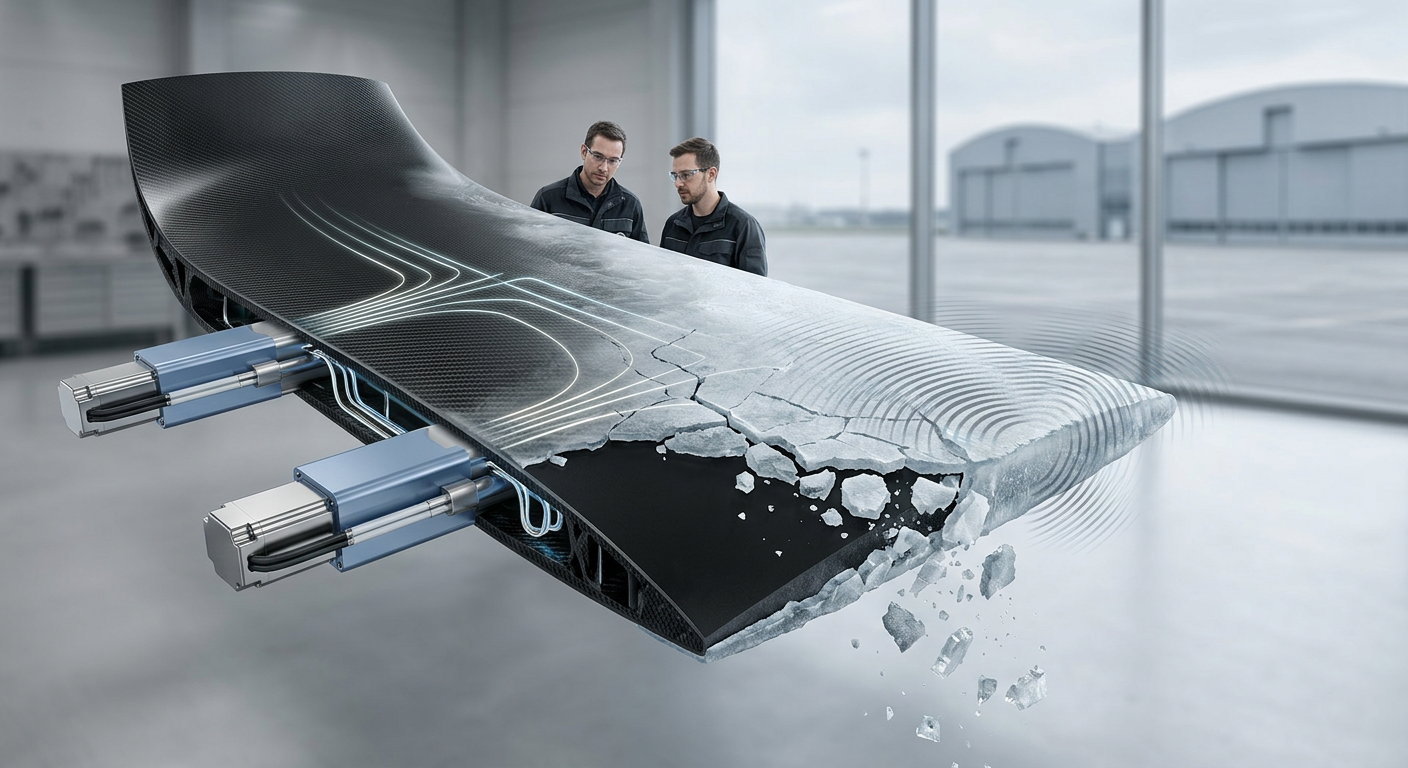
Researchers at the Fraunhofer Institute for Structural Durability and System Reliability (LBF) have developed an energy-efficient method for removing ice from aircraft wings. As part of the Clean Aviation project, the institute, collaborating with partners, has created a system that uses vibrations to cause ice on the wings to crack and detach. This method dramatically reduces the energy required for de-icing compared to traditional methods.
Ice formation on aircraft wings poses a significant safety risk, reducing lift, increasing drag, and potentially impairing the function of control surfaces. Current systems use hot air from the engines, which is energy-intensive and negatively impacts engine efficiency. The new system employs sensors to detect ice formation on specific wing sections. Subsequently, the wing's natural resonance frequency is determined and used to activate piezoelectric actuators. These actuators generate low-frequency vibrations that fracture the ice.
"The vibrations are in the range of just a few kilohertz. They are invisible to the naked eye but very effective. The ice clinging to the wing breaks up and falls off," explained Denis Becker, a researcher at Fraunhofer LBF. The system accounts for various factors influencing resonance frequency, including wing material, flight speed, altitude, temperature, humidity, and ice thickness. Sensors continuously supply new measurement data for the electronics to adjust the frequency.
Fraunhofer LBF's research is part of the European Union's Clean Aviation research and innovation program, with partners including Airbus and Parker-Meggitt. This method is particularly relevant for future aircraft with low-emission propulsion systems that do not produce the waste heat required by current thermal de-icing systems. The new technology is projected to reduce energy consumption by up to 80 percent.
Experiments conducted in an icing wind tunnel have confirmed the method's effectiveness. The next steps involve further wind tunnel tests before the system is ready for in-flight trials. The project aims to meet the aviation industry's increasing demands for reduced energy consumption and carbon emissions.