Global Battery Electrolyte Market to Reach $50.98 Billion by 2034
The global market for battery electrolytes is projected to grow significantly, reaching $50.98 billion by 2034. This expansion is driven by the increasing demand for electric vehicles and grid-scale energy storage solutions.
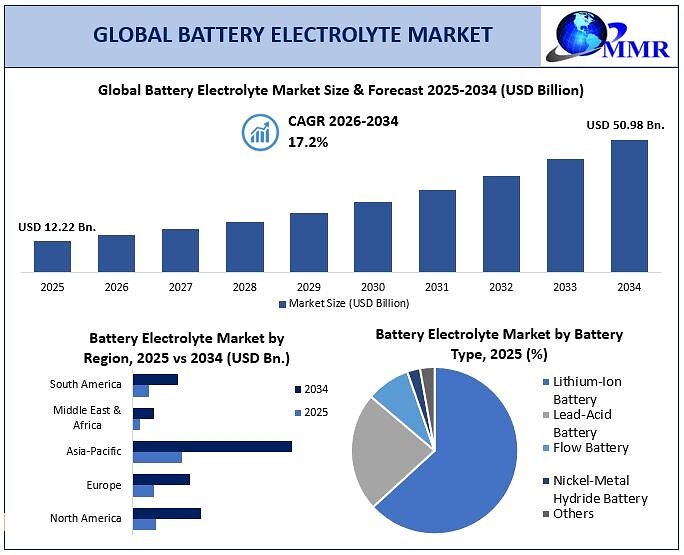
The global battery electrolyte market was valued at $12.22 billion in 2025 and is projected to expand at a compound annual growth rate (CAGR) of 17.2% from 2026 to 2034, reaching $50.98 billion. This growth is attributed to the accelerating demand from electric vehicle (EV) expansion, grid-scale energy storage, and the development of next-generation battery technologies.
Battery electrolytes are crucial for rechargeable batteries, enabling ion movement and directly influencing charging efficiency, battery lifespan, thermal stability, and safety. The market is seeing a shift beyond conventional liquid electrolytes, with manufacturers exploring gel and solid electrolytes, as well as advanced lithium salts, specialty solvents, and additives. Companies are collaborating to enhance fast-charging capabilities, energy density, temperature performance, and cycle life.
Global demand for electrolytes is being fueled by the increasing production of EVs and lithium-ion batteries, alongside the deployment of renewable energy and grid-scale storage. EV battery deployment reached 1.2 TWh in 2025, up nearly 30% from 2024, with EVs accounting for over 70% of total battery deployment. Energy storage additions reached 108 GW in 2025, further supporting market growth.
Key innovations in the battery electrolyte market include advancements in solid-state batteries, sulfide electrolytes, high-voltage formulations, and fast-charging technologies. Companies are investing in new manufacturing facilities and advanced materials. Shenzhen Capchem Technology and Solid Power are among those expanding production and developing next-generation electrolyte solutions. Continued investment in electric mobility and energy storage is expected to drive opportunities through 2034.