Graphitization Furnaces: Four Types and Their Manufacturing Roles
The core graphitization process in carbon production utilizes four main equipment types: Acheson, internal series, box, and continuous furnaces, each with distinct operational characteristics and efficiency levels.
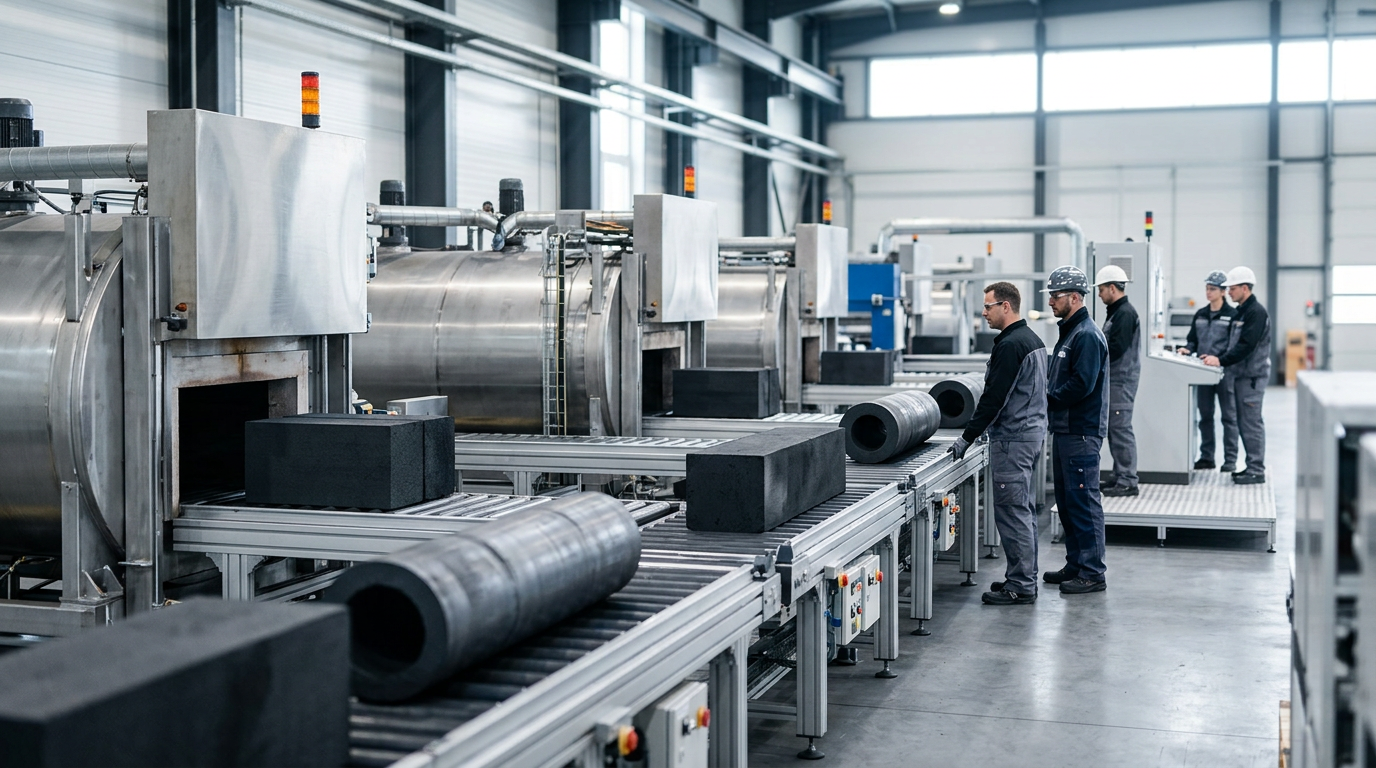
Graphitization, a fundamental step in carbon production, is primarily conducted using four types of industrial furnaces: the Acheson graphitization furnace, internal series graphitization furnace, box-type graphitization furnace, and continuous graphitization furnace. The selection among these depends on specific product requirements and desired production efficiency.
The Acheson furnace, a traditional method, employs resistance heating to reach temperatures between 2,800-3,000°C, making it suitable for high-purity graphite. While structurally simple, it suffers from long production cycles, high energy consumption (4,000-4,800 kWh/t), and lower efficiency. Companies like Putailai and Shanshan continue to use this technology, implementing optimizations to improve energy efficiency.
Internal series furnaces offer higher thermal efficiency by heating directly through electrodes, reducing energy use to approximately 3,300-4,000 kWh/t and shortening high-temperature phases to 1-2 hours. These, particularly the U-type, are widely adopted in Germany, the US, and Japan for producing large graphite electrodes, though their maximum temperature is slightly lower than Acheson furnaces.
Box-type furnaces use carbon or graphite plates as construction and heating elements, aiming to reduce energy consumption. However, they face challenges with material oxidation, thermal efficiency, and temperature uniformity. Companies such as Hebei Kuntian and Shanshan have patented improvements focusing on sealing and power control curves to enhance product consistency.
Continuous graphitization furnaces allow for non-stop material feeding, processing at 2,500-3,000°C, and discharge, significantly increasing production efficiency and automation while lowering energy consumption. This technology is poised to replace older, intermittent methods and is expected to drive substantial increases in anode material production capacity.