Hanbat National University Advances Biosensor Calibration with Machine Learning
New research employs machine learning to speed up and reduce the cost of on-site microcystin toxin monitoring in freshwater without repeated recalibration.
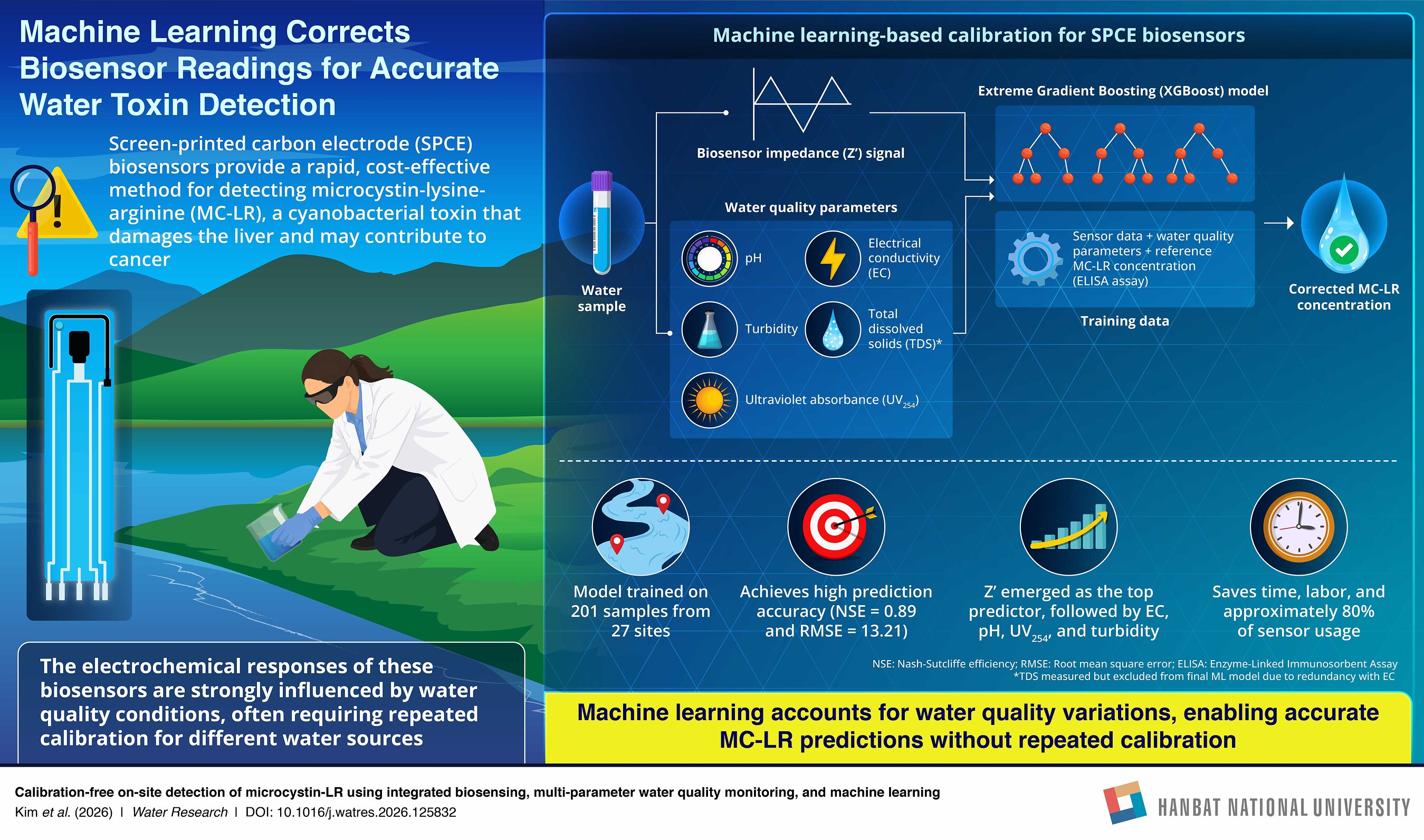
Chungcheong Province, South Korea – Hanbat National University has developed an advancement in on-site microcystin-LR (MC-LR) toxin detection using portable biosensors. The new method integrates machine learning to adjust sensor readings for variations in water quality, enabling faster, lower-cost field testing without the need for frequent recalibration, according to a study published in Water Research.
MC-LR is a potent toxin produced by cyanobacteria during harmful algal blooms, with the World Health Organization setting a guideline value of 1 microgram per liter for drinking water. Conventional electrochemical biosensors face accuracy issues due to interference from water quality parameters such as pH, turbidity, and conductivity, often requiring recalibration for each sample.
Researchers from Hanbat National University and the University of Central Florida developed a machine learning framework that accounts for these environmental factors. The model was trained using extensive data collected from 27 field sites across Florida, covering a wide range of water conditions.
The study highlighted the effectiveness of Extreme Gradient Boosting (XGBoost) algorithms, demonstrating that a single, unified model could accurately predict MC-LR concentrations across diverse water samples. Key factors influencing predictions included the biosensor's electrical impedance, electrical conductivity, pH, UV absorbance, and turbidity.
This data-driven approach is expected to significantly reduce the time, labor, and cost associated with traditional calibration methods. As harmful algal blooms become more prevalent due to climate change, this technology offers a more efficient and accessible way to monitor toxins in freshwater sources.