Hanyang University researchers improve gas sensor sensitivity with light pulse method
Scientists at Hanyang University ERICA have developed a method using 10-millisecond light pulses to enhance the detection of nitrogen dioxide in molybdenum disulfide gas sensors.
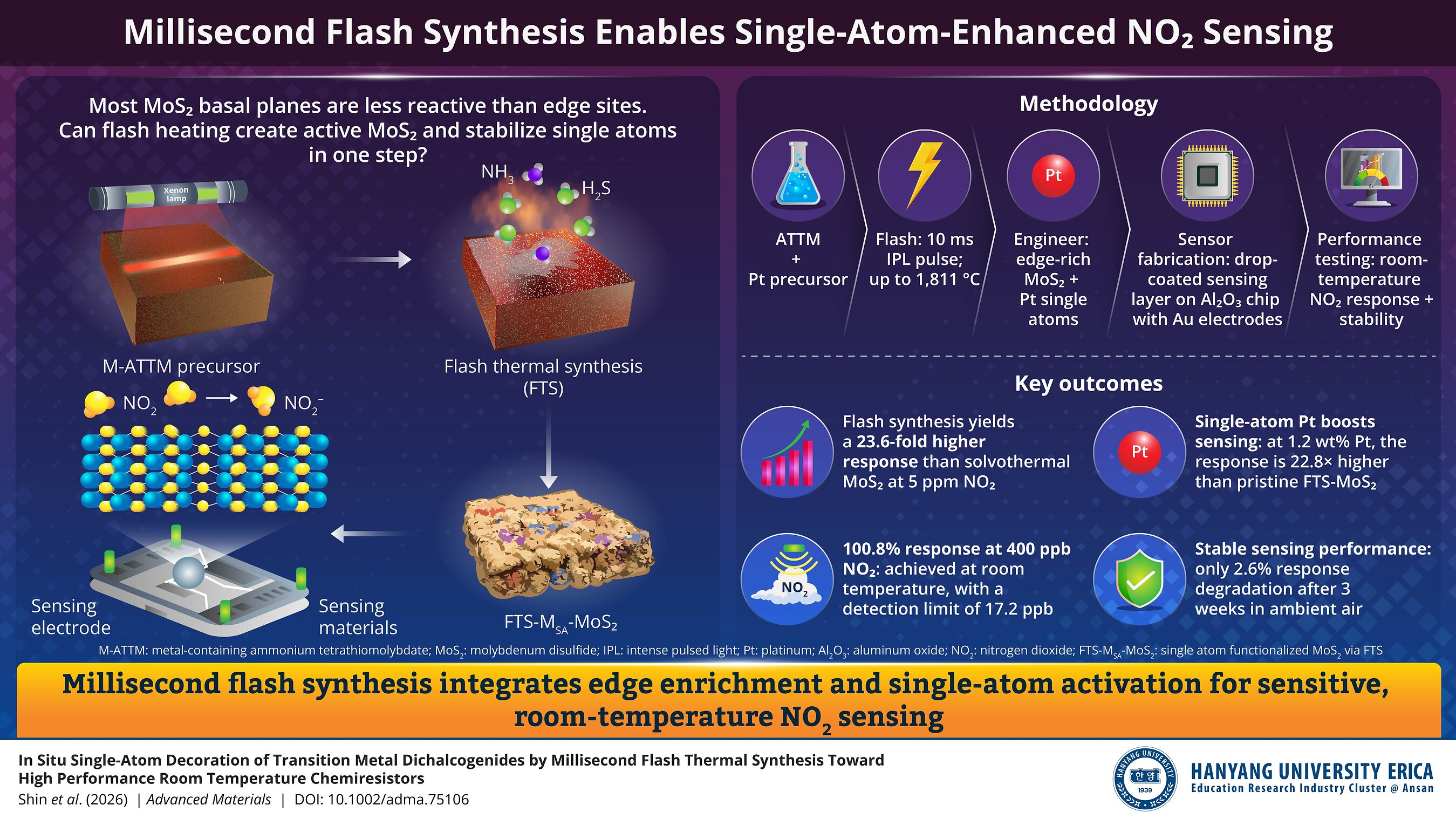
Researchers at Hanyang University ERICA have introduced a new approach to enhance the performance of molybdenum disulfide (MoS₂) gas sensors. By applying a 10-millisecond light pulse, the research team successfully improved the material's ability to detect nitrogen dioxide at room temperature.
MoS₂ is widely researched for its potential in gas sensing, yet the material typically faces constraints regarding sensitivity and response time when operated at standard room temperatures. The new method bypasses the need for high-temperature activation by utilizing a brief light pulse to modulate the material's electrical conductivity.
This finding offers a potential path toward more energy-efficient and responsive gas detection devices. The ability to enhance sensor sensitivity without complex heating systems is expected to influence future designs for industrial and environmental sensing equipment.