Helium observed escaping rocky exoplanet atmosphere
Scientists have observed helium escaping the atmosphere of a rocky exoplanet, offering new insights into planetary atmospheric evolution.
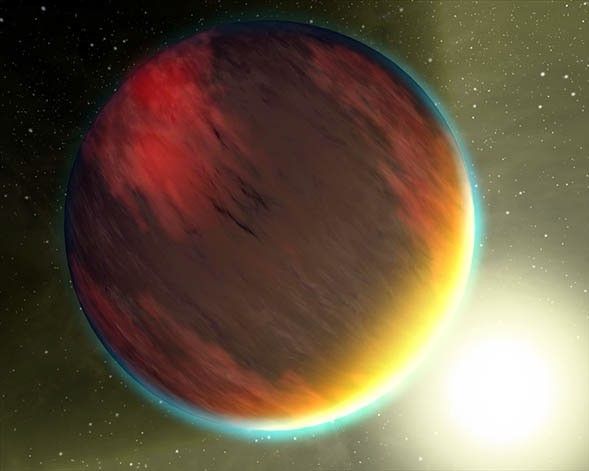
Scientists have observed helium escaping the atmosphere of a rocky exoplanet, providing new insights into planetary atmospheric evolution. The observation was made of a planet orbiting the star LHS 1140, approximately 50 light-years away.
The study, published in Wednesday's issue of Nature, analyzed the rate at which helium is being lost from the planet's atmosphere. Helium, along with hydrogen, is thought to be a common component of the initial atmospheres of planets. Over time and as planets evolve, their atmospheric composition can shift as lighter elements are lost to space or react with other chemicals.
This observation supports the theory that many planets, including Earth, Venus, and Mars, likely lost their primordial hydrogen/helium envelopes and developed secondary atmospheres. Measuring the rate of helium loss helps researchers better understand the factors, such as a planet's gravity, a protective magnetic field, and its proximity to its star, that influence atmospheric retention.
The findings could help refine models for the formation and evolution of exoplanetary atmospheres, which is crucial for assessing the potential for life on other worlds.