Household Composter Market Projected to Reach $386 Million by 2031
The global household composter market is forecast to grow at a CAGR of 7.82% from 2026 to 2031, reaching an estimated value of $386.21 million. Stricter waste diversion mandates and increasing consumer environmental awareness are key drivers.
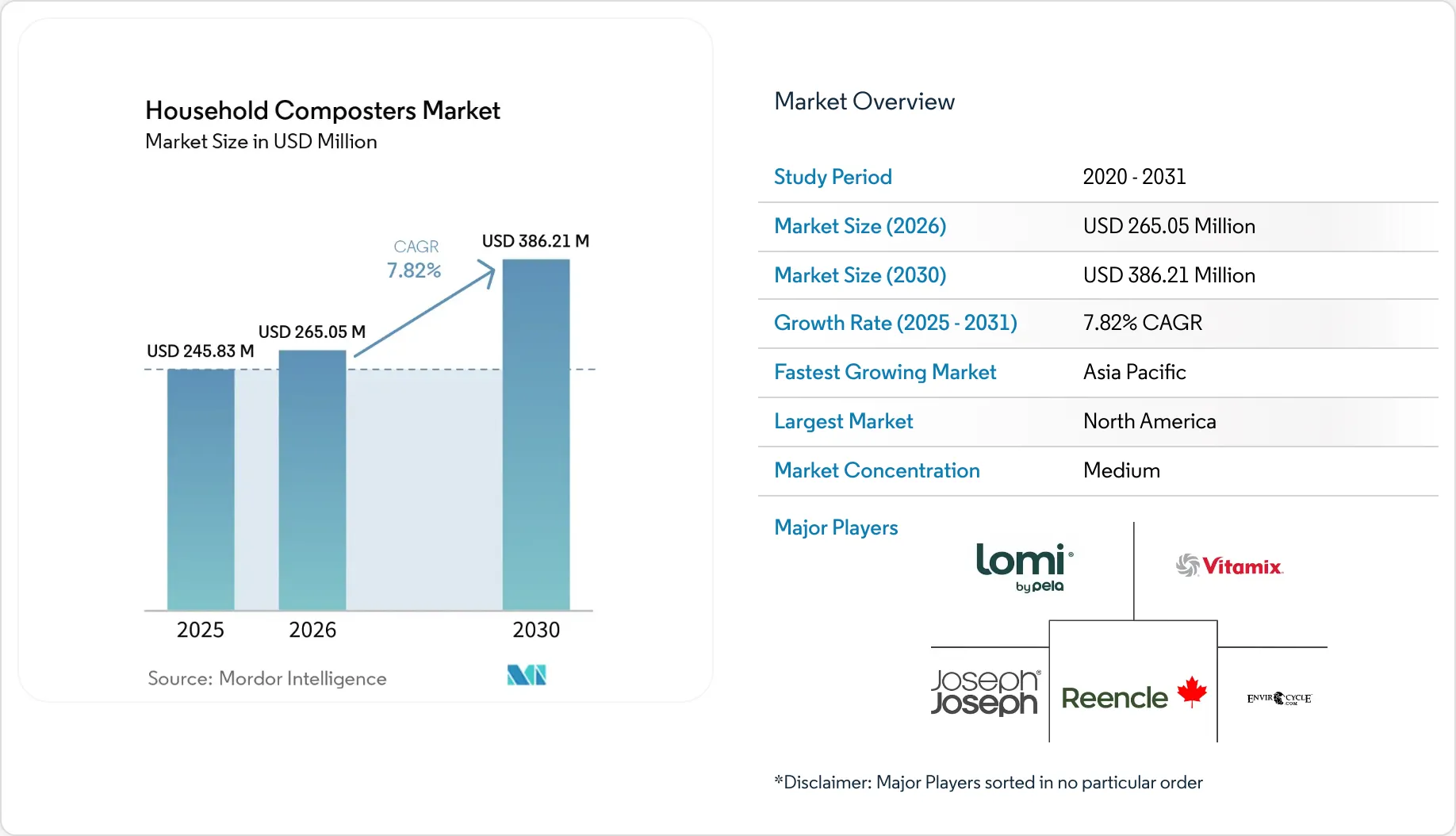
The global market for household composters is projected to experience significant growth, expanding at a compound annual growth rate (CAGR) of 7.82% from 2026 to 2031. The market, valued at approximately $245.83 million in 2025, is expected to reach $265.05 million in 2026 and is forecasted to hit $386.21 million by the end of the forecast period in 2031.
This growth is largely fueled by an increase in government regulations mandating organic waste diversion. Initiatives like California's SB 1383 push for source-separated organics and encourage the use of compost-derived products. The U.S. Environmental Protection Agency (EPA) is also supporting the expansion of composting infrastructure with up to $275 million in funding.
Technological advancements are addressing consumer pain points, including the development of advanced odor filtration systems and smart sensors that predict compost maturity with high accuracy. Electric countertop composters are gaining traction, particularly among urban populations seeking convenient solutions for food waste reduction.
In terms of product types, outdoor bins and tumblers held the largest market share in 2025 at 43.52%, while electric countertop composters are expected to see the fastest growth at an 8.55% CAGR. The under-20-liter capacity segment dominated sales, but the 20-50 liter segment is projected for robust growth at 9.62% CAGR. Online sales are anticipated to grow substantially faster than offline channels, with a projected CAGR of 10.25%.
North America represented the largest market in 2025 with a 35.39% share. However, the Asia-Pacific region is forecast to exhibit the highest growth rate, driven by a CAGR of 8.92%. These trends indicate a global shift towards more sustainable waste management practices at the household level.