LMU Munich Researchers Advance Quantum Computing Using Individual Atoms
Researchers at Ludwig-Maximilians-Universität München (LMU) are developing quantum computing methods based on individual atoms. The startup planqc aims to leverage this technology for practical applications.
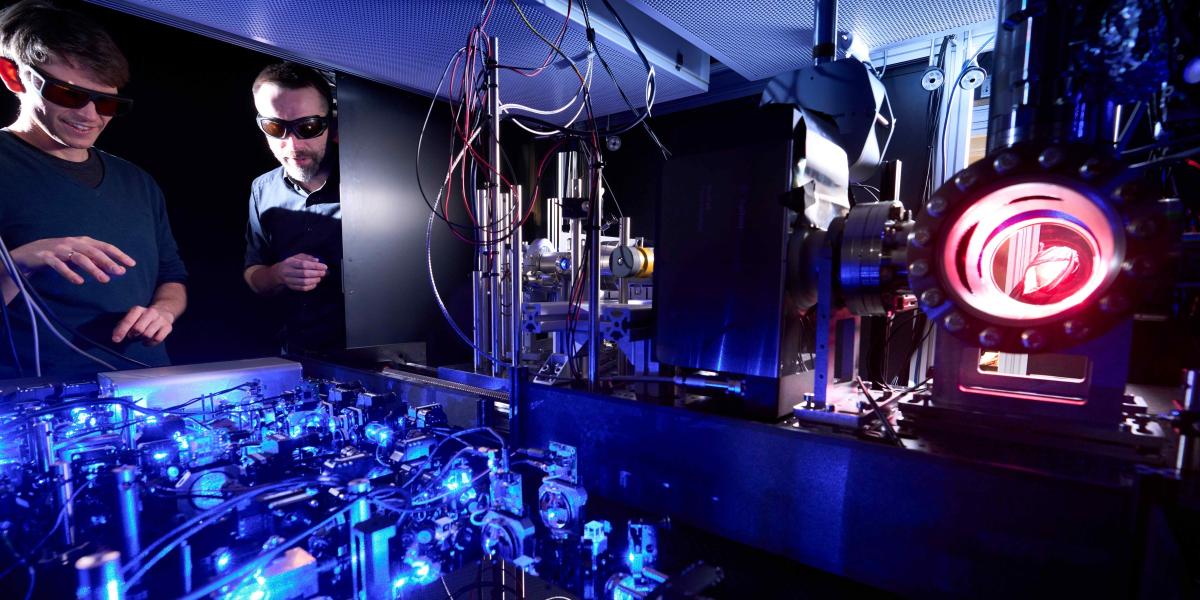
Physicists at Ludwig-Maximilians-Universität München (LMU) are advancing the field of quantum computing by focusing on the controlled manipulation of individual atoms. This research has led to the establishment of planqc, a startup company dedicated to harnessing the potential of atomic-level quantum computation.
The ability to precisely control quantum mechanical phenomena underpins many modern technologies. While previous advancements often involved controlling large numbers of particles, such as photons or electrons, the targeted control of individual atoms offers a new frontier. Theoretical concepts for using atoms in computation have existed since the 1990s, but recent technological progress in handling single atoms has made experimental realization feasible, according to Professor Johannes Zeiher.
Key foundational work includes Ted Hänsch's research on laser cooling in the 1970s, which paved the way for studying complex atomic systems. Developments like Immanuel Bloch's quantum gas microscope, which allows individual atoms to be visualized, have significantly improved control, enabling experiments where atoms can be used for calculations.
Quantum computing operates differently from classical computing, which uses bits representing either 0 or 1. Quantum computers utilize quantum bits, or qubits, which can exist in a superposition of both states simultaneously. This capability allows quantum computers to explore a vastly larger computational space, offering potential for solving complex problems intractable for traditional machines.
In this approach, stable states within atoms are defined as computational bits. Lasers are then used to create the necessary superposition states for quantum calculations. The process requires cooling the atoms and employing techniques like optical tweezers to precisely position and manipulate them, ensuring accurate quantum computations.