Media Planning Market to Reach $11.35 Billion by 2031
The global Media Planning market is projected to grow at an 11.32% CAGR, reaching $11.35 billion by 2031. Growth is driven by AI adoption and programmatic planning.
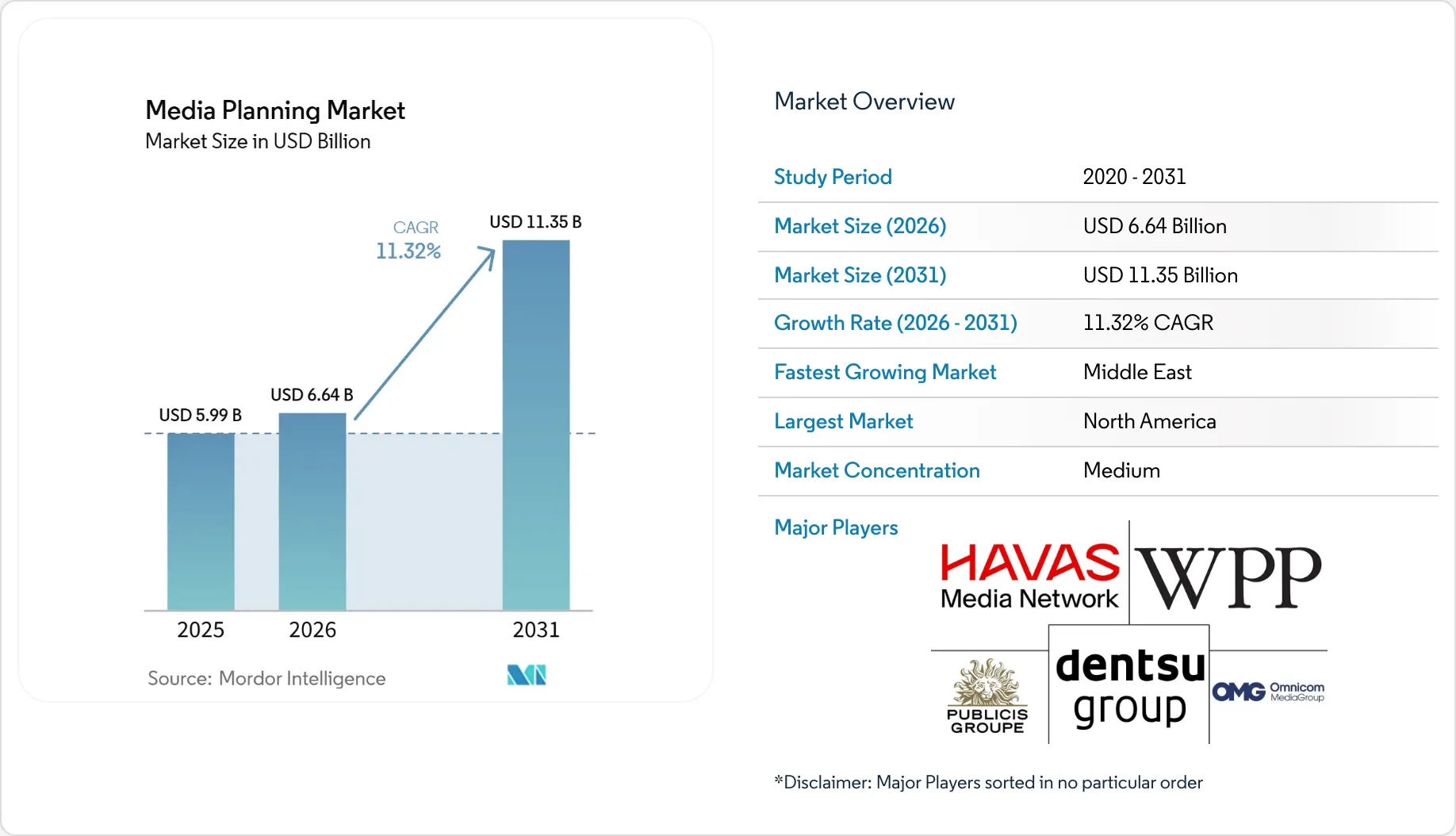
The global Media Planning market is projected to expand from $6.64 billion in 2026 to $11.35 billion by 2031, demonstrating a compound annual growth rate (CAGR) of 11.32%, according to a new report by Mordor Intelligence. This growth is attributed to the increasing adoption of artificial intelligence (AI) in campaign planning, a rise in addressable advertising inventory, and a stronger demand for evidence of incremental returns on advertising spend.
The industry is shifting from manual calendar construction to data-driven systems for budget allocation and inventory evaluation. Large agency groups are developing integrated data and AI platforms, while independent tech providers are addressing gaps in planning, measurement, and activation. However, privacy regulations and signal loss remain significant constraints, impacting the accuracy of audience matching and frequency models.
In 2025, large enterprises held the dominant share of the market at 63.92%. Small and medium-sized enterprises (SMEs) are expected to exhibit faster growth, with a projected CAGR of 12.41% through 2031. In terms of planning objectives, audience planning accounted for 30.12% of revenue in 2025, while budget allocation and scenario planning are anticipated to grow robustly at a CAGR of 14.23%.
By end-use sector, retail and e-commerce represented the largest segment with 24.23% of market revenue in 2025. The healthcare and life sciences sector is forecast to experience significant growth at a CAGR of 13.91%. Geographically, North America dominated the market in 2025 with a 36.38% share, while the Middle East is expected to grow at a CAGR of 12.12%.
The report also highlights opportunities in tools that unify reach, frequency, and scenario planning across connected TV, audio, social media, and retail media channels. The transition to algorithmic and programmatic planning is expected to be a key driver in the short term.