New Tools Help Writers Identify AI-Generated Text
Writers are increasingly concerned about their work inadvertently sounding like AI. New tools are emerging to help detect and revise text, guiding authors to avoid linguistic quirks and phrases that reveal machine origin.
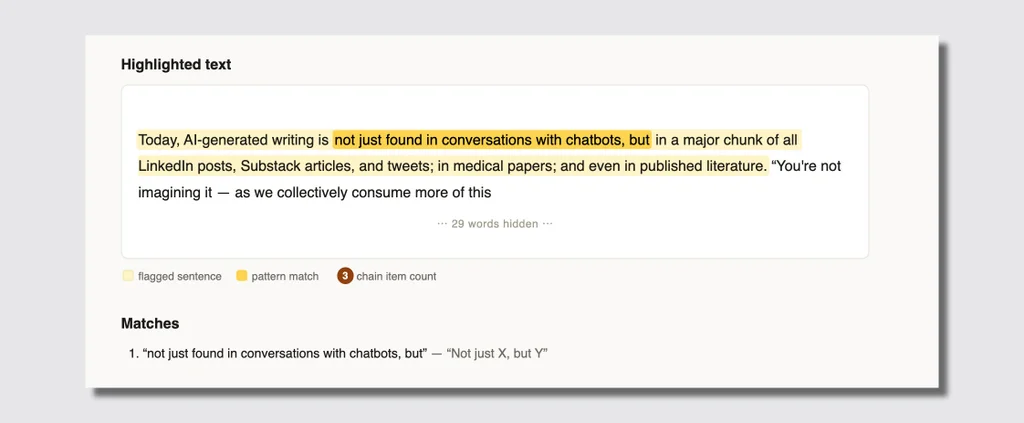
Writers who do not use artificial intelligence (AI) are beginning to worry that their output is starting to resemble machine-generated content. In response to this challenge, new tools are being developed to help identify and revise writing to eliminate AI-typical characteristics.
George Strakhov, an AI automation consultant and creator of the tool Slop Tells, notes that AI models often employ a recognizable linguistic style. "These models do speak in a specific way, and you develop a sense of it—you develop the smell of the writing," Strakhov said.
One such tool is the LLM Cliché Highlighter, designed by Simon Willison. It scans text for 38 common AI-associated phrases, including rhetorical tics and clichés. Users can input their text, and the tool highlights flagged sentences and provides a total count. While useful for an initial assessment, the tool's scope is limited and may not evolve with rapidly changing language models.
Slop Tells, created by Strakhov, aims to keep pace with AI development. The tool continuously reassesses which phrases and constructions have become AI telltales. Strakhov's model utilizes a comprehensive database combining older human-written text with content produced by current AI models. This comparison helps identify emerging AI traits, such as the word 'delve,' previously common in AI but now largely phased out. Newer identified traits include words like 'genuinely' and phrases like 'what (actually) matters.'
Slop Tells offers a more granular analysis than the LLM Cliché Highlighter, indicating not only identified jargon but also whether that trait is currently active in AI models or fading. This provides writers with a more informed understanding of potential machine-like elements in their writing.