Night Street Photography: Camera Settings and Light Usage
Night street photography focuses on capturing desired movement in appropriate light, rather than illuminating the entire scene. Camera settings should serve the chosen subject, distinguishing between moving and static elements.
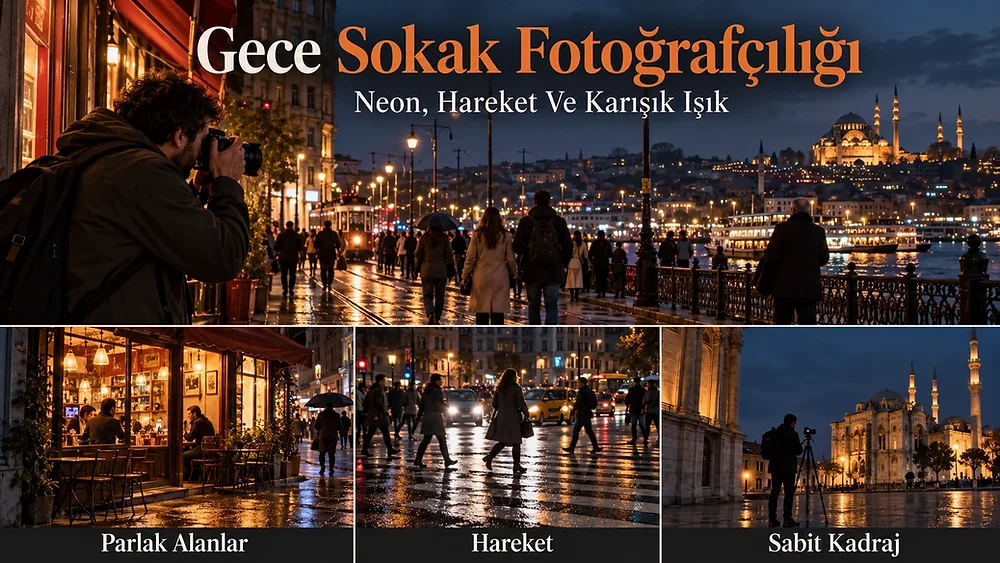
In night street photography, light tends to fragment rather than uniformly illuminate the environment. The warm glow of a shop window, the color of a neon sign, and a passerby's shadow can all merge in a single frame. Successful night shots don't require a brightly lit street, but rather focus on capturing the intended action and utilizing light effectively, according to Flaşçı.
More critical than the quantity of light is the ability to identify bright areas within the subject. These might include storefronts, illuminated doorways, or street lamps. Camera settings, such as shutter speed, aperture, and ISO sensitivity, should support the chosen subject. Particularly when photographing moving subjects like people, the shutter speed must be short enough to freeze motion, while longer speeds can convey a sense of movement.
The interplay of light and shadow is central to night photography. A person's figure might appear in light and recede into shadow within moments, and a wet pavement can reflect signage. The choice of camera settings depends on whether the goal is to freeze motion or depict it as a blur. For instance, a shutter speed of 1/250 second might freeze a walking person, while 1/30 second could create a motion trail.
A wide aperture (low f-number) facilitates shorter shutter speeds but can limit depth of field. This is suitable when the main subject is a single person. If the image tells a story with multiple layers, a narrower aperture and higher ISO might be necessary. Auto ISO can be practical in varying light conditions, but its upper limit should be determined through test shots suited to the specific camera and conditions.
When photographing neon signs and bright displays, preserving highlights is crucial. The camera might overcompensate for dark areas, causing colorful details to be lost. By identifying the bright areas essential to the photograph's narrative, one can ensure they are retained with detail and clarity.