NYU Researchers Solve Reverse Sprinkler Problem
Researchers at New York University have found a solution to a fluid dynamics problem popularized by physicist Richard Feynman. The findings also explain the behavior of 'silly sprinklers.'
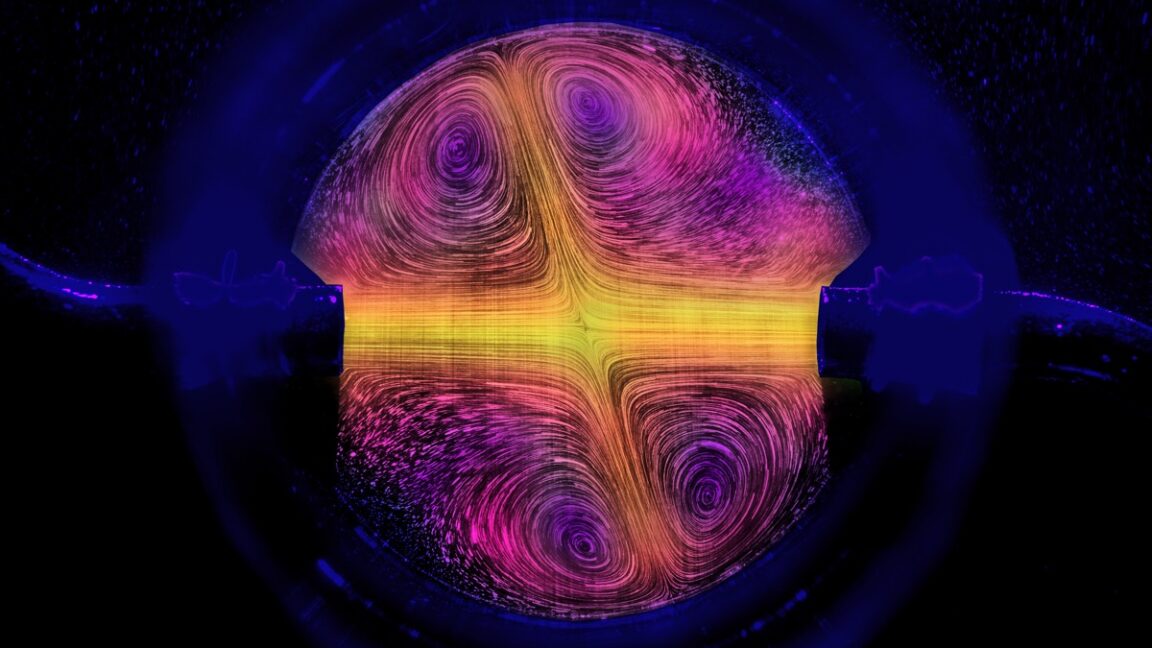
New York University's Courant Institute researchers have solved the "reverse sprinkler problem," a fluid dynamics challenge that has puzzled scientists and educators for decades. The solution, detailed in the Proceedings of the National Academy of Sciences, also sheds light on the water patterns created by decorative "silly sprinklers."
The problem, which dates back to Ernst Mach's 1883 textbook 'The Science of Mechanics,' gained wider attention when physicist Richard Feynman explored it in the 1940s. Feynman famously described the counter-intuitive nature of the problem, noting that different thinkers arrived at opposing conclusions regarding the expected rotation of a reverse sprinkler.
Unlike a standard sprinkler that rotates outward due to water expulsion, a reverse sprinkler expels water inward. Early hypotheses assumed a simple reversal of motion, but experiments and theoretical analysis revealed a more complex dynamic. The NYU team's work provides a unified explanation for these dynamics.
The study utilized experimental data from various "silly sprinkler" designs, which create decorative water loops and spirals. The researchers found that the solution to the historical reverse sprinkler problem directly applies to understanding the physics behind these playful devices, bridging theoretical fluid mechanics with practical applications.
The findings offer a clear resolution to a long-standing question in fluid dynamics, demonstrating how basic physics principles govern seemingly simple mechanical behaviors. The research connects historical scientific inquiry with modern experimental techniques and observations.