Oral Controlled Release Drug Delivery Market to Reach $90.45 Billion by 2036
The global oral controlled release drug delivery technology market was valued at $42.10 billion in 2025. Sales are projected to reach $90.45 billion by 2036, with a CAGR of 7.20%.
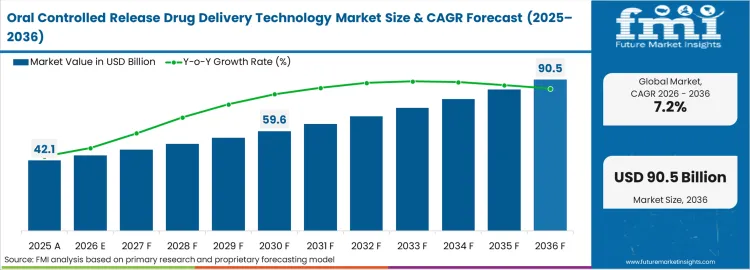
The global market for oral controlled release drug delivery technology was valued at $42.10 billion in 2025. Future Market Insights (FMI) analysis projects the market to grow to $45.13 billion in 2026 and reach a total valuation of $90.45 billion by 2036. The market is expected to experience a compound annual growth rate (CAGR) of 7.20% during the forecast period.
Key drivers for market expansion include the increasing prevalence of chronic diseases such as hypertension, diabetes, and central nervous system disorders. These conditions necessitate long-acting oral formulations that maintain therapeutic drug levels for extended periods, reducing dosing frequency and improving patient compliance. Pharmaceutical companies are also leveraging controlled release technologies to reformulate existing drugs, extending product lifecycles and creating new intellectual property.
The FMI report segments the market by drug release system and dosage form. Diffusion-controlled release systems accounted for a 25.5% share in 2026, representing the primary category. Solid dosage forms, including tablets and capsules, held an 81.2% share, reflecting their widespread adoption due to manufacturing scalability and patient acceptance.
Geographically, India is identified as a significant growth market, with a projected CAGR of 5.50% through 2036. This is attributed to the country's robust generic pharmaceutical industry, which is a major developer of controlled-release oral formulations for global export. Analysts note that while diffusion-controlled systems are established, osmotic and matrix systems are gaining traction due to their superior release kinetics.
The market is anticipated to add approximately $45.32 billion in absolute terms between 2026 and 2036, driven by ongoing demand for chronic disease management and pharmaceutical lifecycle strategies.