Overview of AI Video Enhancement Software in 2026
CrePal reviews the current landscape of AI video enhancement, highlighting the technical distinctions between upscaling and content restoration.
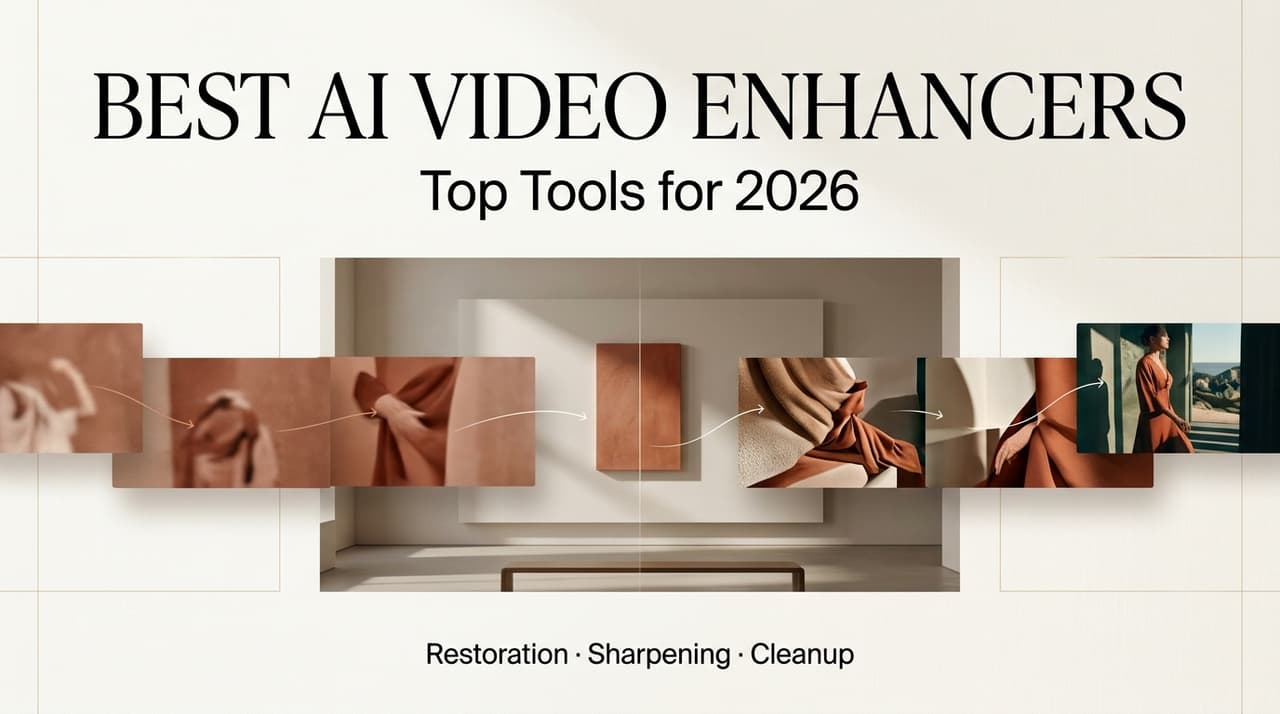
As of 2026, the market for AI video enhancement offers various specialized solutions rather than a single definitive tool. Successful video restoration requires a strategic approach, specifically distinguishing between resolution upscaling—which synthesizes new pixels—and image enhancement, which addresses noise, motion blur, and stabilization.
Topaz Video AI remains a primary tool for professional workflows, particularly for its temporal awareness. By analyzing sequences frame-by-frame, it minimizes flickering artifacts common in lower-end sharpening software. However, users require significant GPU resources to maintain efficient render times, as the software is computationally intensive.
AVCLabs Video Enhancer AI occupies a distinct niche, focusing on colorization and light correction. It is frequently employed for archival restoration, such as converting black-and-white footage or updating SDR content to HDR. While effective for animation and historical assets, its performance on human faces can occasionally produce artificial results.
Industry consensus underscores that the order of operations is critical. Attempting to upscale noisy footage without first performing denoising typically exacerbates visual imperfections. Selecting the correct software depends on identifying the primary defect—whether it is resolution, color degradation, or motion jitter—rather than applying broad filters to all media.