PI's Motion Technology Confirmed Operating on NASA's Roman Space Telescope
PI (Physik Instrumente), a provider of precision motion control technology, has supplied components for NASA's Roman Space Telescope's Coronagraph Instrument. Initial checkout in space has been confirmed as successful.
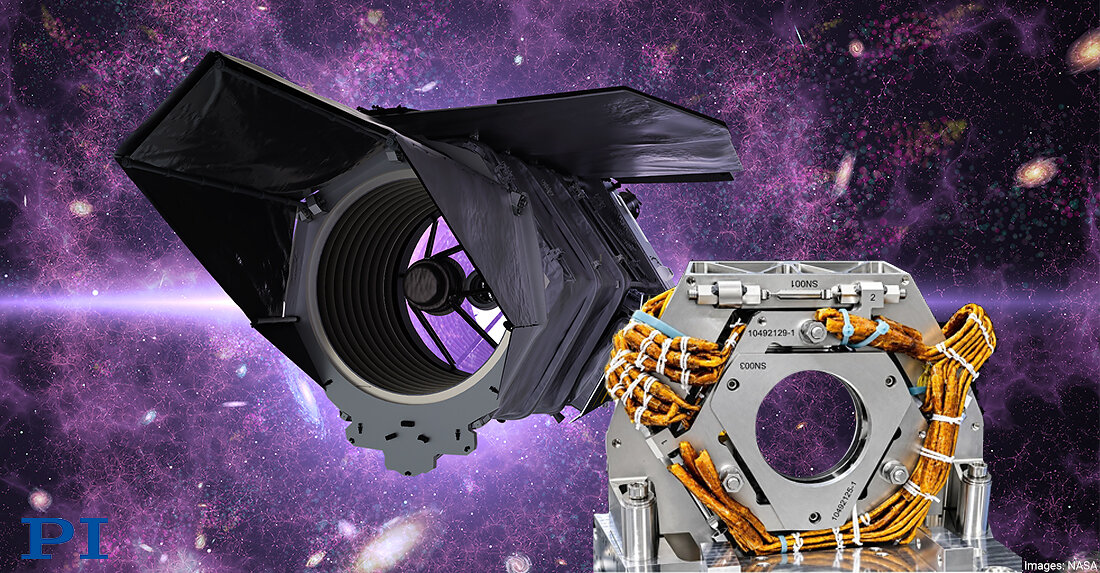
SHREWSBURY, Massachusetts – PI (Physik Instrumente), a global supplier of nanopositioning and precision motion control technology, has provided piezoelectric actuators that drive a fast-steering mirror in the Coronagraph Instrument aboard NASA's Roman Space Telescope. NASA has confirmed that initial checks of the Coronagraph Instrument were successful following its activation in space. The instrument remains in commissioning as Roman travels toward the Sun–Earth L2 point. PI also contributed multiple precision motion solutions employed over the last decade during the telescope's design and test phase.
The Roman Space Telescope launched aboard a SpaceX Falcon Heavy on August 30, 2026. Once fully commissioned, the observatory will conduct wide-field surveys to study dark energy, dark matter, and exoplanets, with first science observations expected in early 2027.
At the center of the Coronagraph Instrument's fine-pointing system are three PI multilayer piezoelectric actuators, arranged in a triangular configuration to drive the instrument's fast-steering mirror. Integrated strain-gauge sensors provide closed-loop position feedback for nanoradian-scale pointing precision— a capability essential to the Coronagraph's mission of suppressing starlight so faint, orbiting exoplanets can be directly imaged.
The PICMA actuator technology was previously qualified by NASA for Mars surface operations, where testing demonstrated more than 100 billion operating cycles without failure — a reliability record that supported its selection for Roman's demanding pointing requirements.