Rohde & Schwarz Publishes White Paper on Future of UWB Technology
Rohde & Schwarz has released a white paper detailing advancements in Ultra-Wideband (UWB) technology under the IEEE 802.15.4ab standard. The publication explores enhancements for precision ranging and new sensing capabilities.
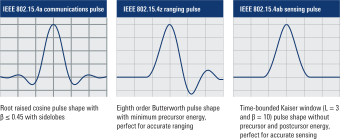
Munich – Rohde & Schwarz has published a comprehensive white paper exploring the future of Ultra-Wideband (UWB) technology and the advancements introduced in the IEEE 802.15.4ab standard. The release provides in-depth insights into UWB's evolving capabilities, which are driving new use cases in precision ranging, secure access, and advanced sensing across consumer electronics, automotive systems, and industrial applications.
The new IEEE 802.15.4ab standard brings significant enhancements to UWB's physical and MAC layers. The white paper covers topics such as improved modulation schemes, dynamic data rate adaptation, multi-millisecond ranging techniques, and new capabilities for radar-based sensing. These advancements are expected to enable future applications including vital sign detection and immersive media sharing.
The document delves into the standard's architecture and features, including enhanced modulation and coding schemes, multi-millisecond UWB ranging methods, and narrowband-assisted modes. It also addresses standardized radar/sensing packet structures, frequency stitching, and power-saving wake-up radios and low-energy UWB (LE-UWB).
Rohde & Schwarz is offering the white paper for download via its website. This publication is part of the company's commitment to supporting the development of UWB technology and providing new testing solutions for industry stakeholders.