Self-Driving Cars Regulatory Timeline and Roadmap to 2035
DataM Intelligence has released a report detailing the regulatory roadmap for self-driving cars until 2035, covering AV regulations, robotaxi deployment, and market readiness.
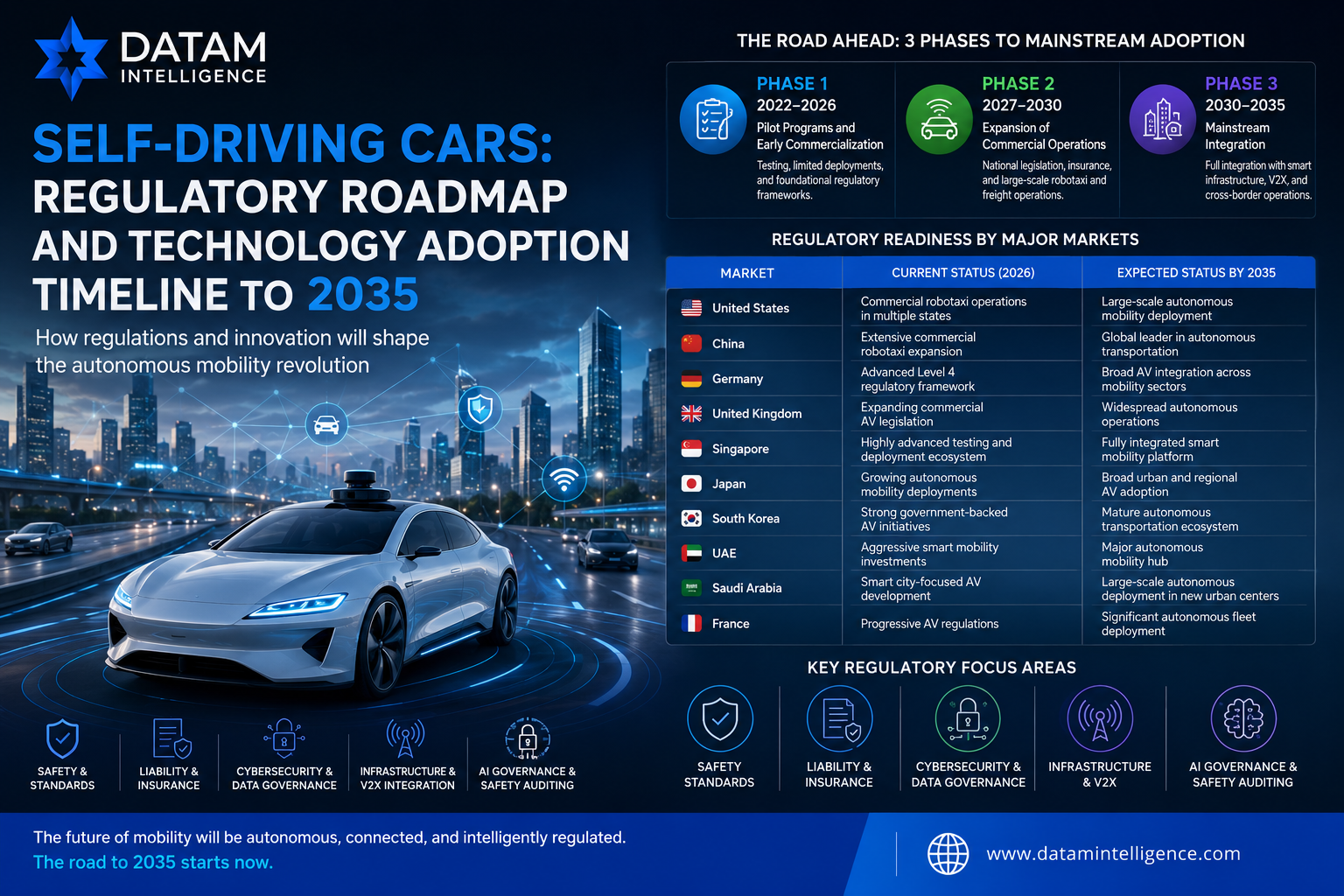
DataM Intelligence has published an analysis outlining the regulatory timeline and roadmap for the widespread deployment of self-driving cars through 2035. The report examines the evolution of autonomous vehicle regulations, including those for robotaxi services, Level 4 autonomy, cybersecurity, AI governance, and V2X infrastructure across major global markets.
As of 2026, autonomous vehicles have progressed from experimental pilot programs to limited commercial operations in select cities worldwide. While advancements in AI and sensor technology are accelerating development, regulatory frameworks remain the most critical factor for large-scale adoption. Governments globally are actively developing new regulations concerning safety standards, liability, cybersecurity, data management, and operational approvals.
The United States and China are projected to lead in commercial robotaxi operations by 2035, with China expected to become a global leader in autonomous transportation. Germany and the United Kingdom are advancing their Level 4 regulatory frameworks for broader integration across mobility sectors. Other key markets like Singapore, Japan, and South Korea are also focusing on testing and deployment ecosystems for autonomous mobility.
The report divides the timeline into three phases: Phase 1 (2022-2026) focuses on pilot programs and early commercialization with limited regulatory approval. Phase 2 (2027-2030) will see the expansion of commercial operations and the development of national legislation covering licensing, insurance, and liability. Phase 3 (2030-2035) predicts mainstream integration, requiring regulations for vehicle interoperability, traffic control systems, and smart city integration.