Seoul Tech Researchers Develop Energy-Saving Feet for Quadruped Robots
Researchers at Seoul National University of Science and Technology have developed new energy-saving 3D-printed robot feet controlled by AI. This innovation reduces power consumption in quadruped robots by up to 6.2%.
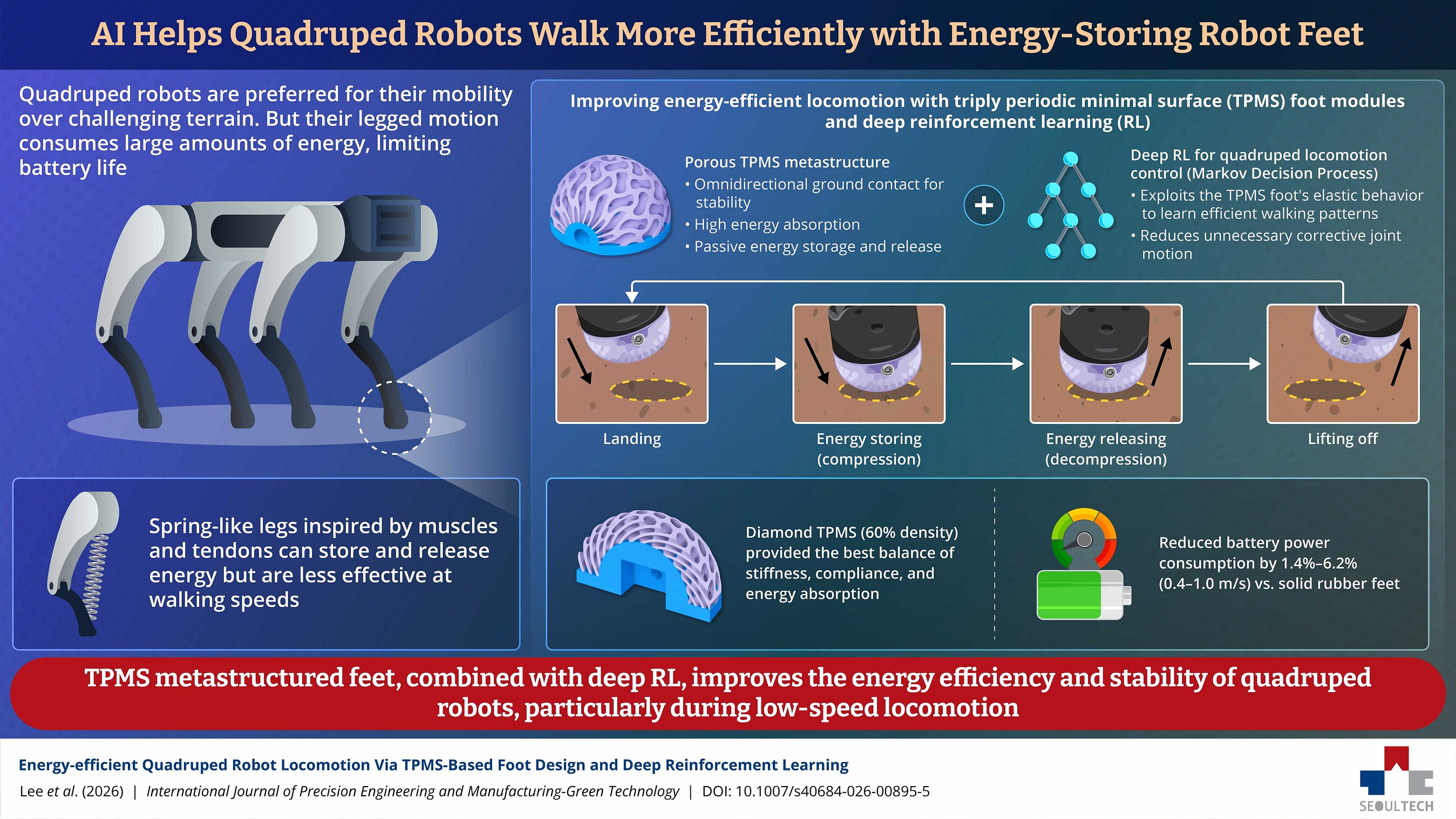
Researchers at Seoul National University of Science and Technology (Seoul Tech) have developed novel, energy-efficient feet for quadruped robots. These 3D-printed, porous feet are designed to store and release energy during robot locomotion. When combined with a controller utilizing deep reinforcement learning, this approach reduces power consumption by up to 6.2%.
Quadruped robots are increasingly deployed for tasks such as inspection, transportation, and search-and-rescue operations. However, their leg movements consume significantly more energy than wheeled robots. Drs. Keun Park and Jung-Yup Kim addressed this by developing feet utilizing triply periodic minimal surface (TPMS) metastructures. These materials are lightweight and possess excellent capabilities for absorbing and releasing impact energy.
The study involved the design and 3D printing of three TPMS foot variations: primitive, gyroid, and diamond. The diamond design was identified as optimal due to its flexibility, energy storage capacity, and minimal energy loss. To maximize the potential of these feet, the researchers developed a deep reinforcement learning-based control system. This system learned to coordinate the robot's gait with the feet's energy storage and release characteristics, thereby minimizing the required work from the motors.
Testing of the modified robot revealed that the TPMS feet reduced energy consumption by 1.4% to 6.2% compared to conventional robot feet. This efficiency gain was most pronounced at walking speeds between 0.4 and 1.0 meters per second. The researchers suggest this technology could lead to quieter and more energy-efficient quadruped robots for indoor service, inspection, and logistics applications. The study was published in May 2026 in the International Journal of Precision Engineering and Manufacturing-Green Technology.