Slow-Release Micronutrients Market Projected to Reach $366.4 Million by 2036
The slow-release micronutrients market is expected to grow at an 8.8% CAGR, reaching $366.4 million by 2036. Mineral or bio-based carrier systems are projected to lead demand, with zinc products dominating nutrient types.
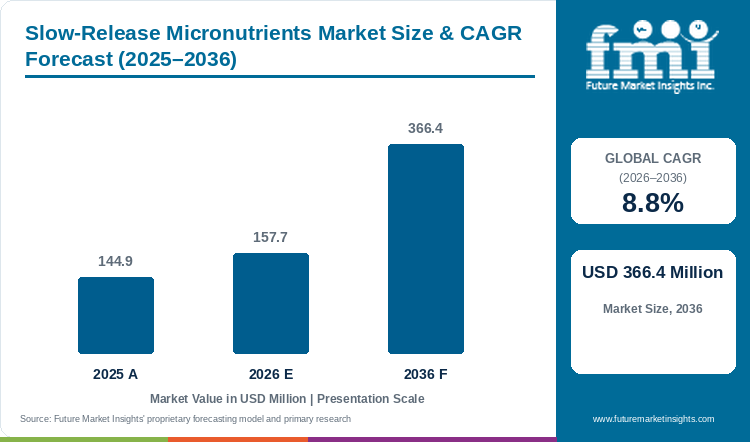
The global market for slow-release micronutrients is projected to expand at a compound annual growth rate (CAGR) of 8.8% from 2026 to 2036, growing from an estimated $157.7 million in 2026 to $366.4 million by 2036.
Mineral or bio-based carrier systems are anticipated to be the primary driver of demand, capturing an estimated 46.2% market share in 2026. These systems are favored for their ability to keep micronutrients such as zinc, boron, iron, and manganese available for crop uptake over extended periods. Zinc products are expected to constitute the largest nutrient category, accounting for 34.8% of the market in 2026, due to their widespread application in cereals, oilseeds, and horticulture.
Cereals and grains are forecast to represent 40.8% of the total demand in 2026. Soil incorporation and dry blending are expected to be the dominant application methods, holding a 48.6% share. Agri-input distributors are anticipated to account for 40.6% of sales in 2026, as these specialized products often require local guidance on application, dosage, and compatibility with existing fertilizer programs.
Regionally, Germany is identified as the fastest-growing market with an 8.4% CAGR. The United States and South Korea are also expected to experience significant growth. The existing infrastructure for fertilizer application and nutrient management plans in many agricultural regions is creating opportunities for the adoption of slow-release micronutrients, allowing integration into current farming practices.