The Evolution of the Camera: From Camera Obscura to Digital
The history of photography traces a path from the camera obscura to the digital age, marked by innovations in chemistry and optics that democratized image capture.
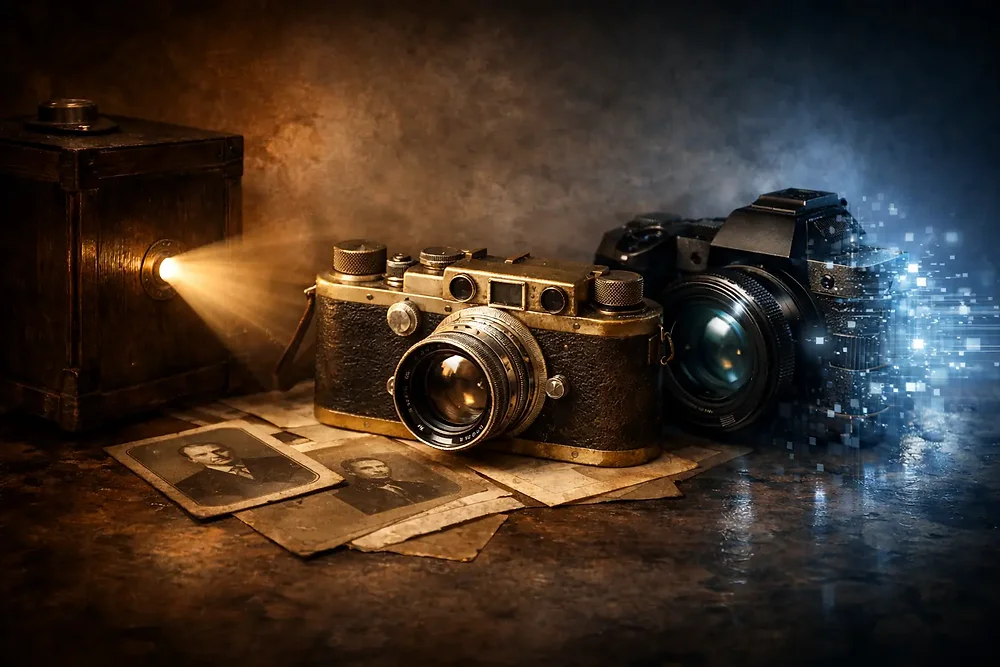
The journey of the camera began long before photography, with the principle of the camera obscura, or "dark room." By the 11th century, Arab mathematician Ibn al-Haytham had documented how light passing through a small aperture into a darkened space could project an inverted image onto an opposite surface. This phenomenon became a tool for artists during the Renaissance, aiding in perspective and composition.
The quest to permanently capture these projected images led to significant advancements. In 1826 or 1827, Joseph Nicéphore Niépce created what is considered the first permanent photograph, requiring an exposure of several hours. His partner, Louis Daguerre, later introduced the daguerreotype in 1839, producing sharp, unique images on silver-plated copper sheets. In the same year, William Henry Fox Talbot developed the calotype, a negative-positive process that allowed for multiple prints and laid the foundation for modern photography.
The 19th century continued to see rapid development. The collodion process offered improved clarity and reproducibility but demanded immediate processing. The invention of gelatin silver halide emulsions in 1871 made plates pre-processable. George Eastman revolutionized accessibility with the Kodak No. 1 camera in 1888, marketed with the slogan "You press the button, we do the rest," making photography a mass-market product.
By the 20th century, the introduction of the 35mm format, popularized by Leica, transformed photojournalism and documentary work. Medium format and single-lens reflex (SLR) cameras, such as Rolleiflex and Exakta, became industry standards. Japanese manufacturers like Nikon and Canon later dominated the professional market with robust and advanced SLR systems.
Instant photography arrived with Edwin Land's Polaroid in 1948, bringing images directly from camera to hand within minutes. The digital revolution began with the invention of the CCD sensor in 1969 and the development of the first digital camera by Steve Sasson at Kodak in 1975, paving the way for the digital imaging technology prevalent today.