US Public Pensions Reach Best Funded Status Since 2009, But Face $1.13 Trillion Shortfall
US state and local pension systems have reached an 85% funded ratio in 2026, the highest since 2009, according to Equable Institute. However, total unfunded liabilities remain at an estimated $1.13 trillion.
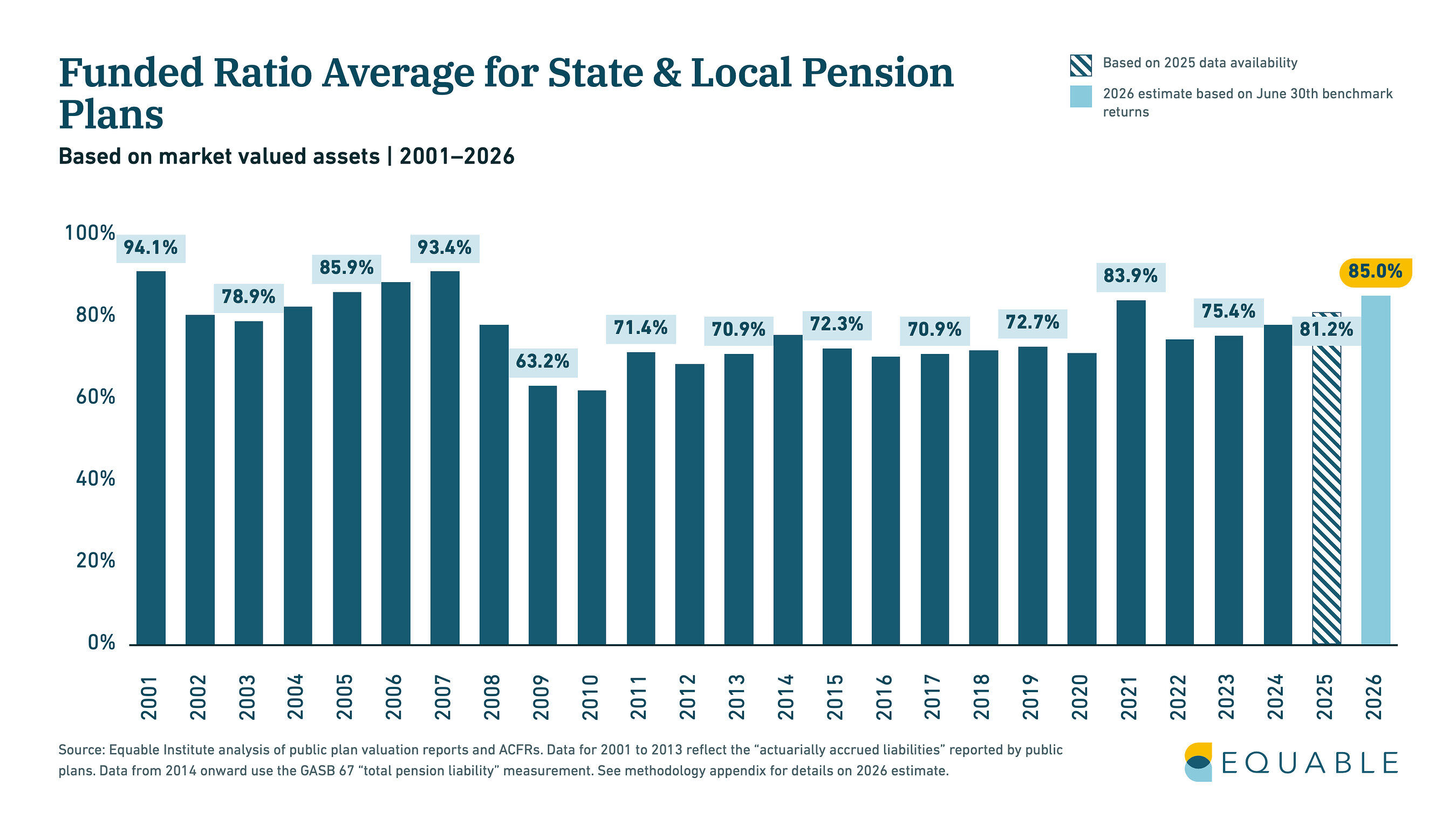
America's state and local public pension systems have achieved their strongest funded position since 2009, with the national funded ratio projected to reach 85.0% in fiscal year 2026. This marks the fourth consecutive year of improvement, driven by investment returns exceeding targets. The analysis by the Equable Institute, detailed in its seventh annual State of Pensions report, covers 253 retirement systems across all 50 states and the District of Columbia.
Total unfunded liabilities for these pension plans have fallen to an estimated $1.13 trillion, down from $1.37 trillion in 2025. Plans are projected to earn an average investment return of 9.4%, significantly exceeding their assumed target of 6.9% for the fourth year in a row. Notably, 45 states have seen their funded status improve, and seven systems are now fully or overfunded.
Despite the positive trend in funding ratios, the report highlights two significant structural risks. Many pension funds are converging in their investment strategies, leading to similar portfolios concentrated in a few large companies. This homogeneity increases vulnerability to widespread market downturns. Furthermore, over a quarter of pension assets are now invested in assets whose value is estimated rather than determined by open market transactions, reaching a record high.
A substantial concern is the growing exposure to artificial intelligence (AI) related companies. Equable estimates that 8% to 10% of public pension assets, approximately $513 billion to $642 billion, are directly invested in AI-related sectors. "While many states are reporting strong funded status, they are heavily relying on the accuracy of private equity and real estate valuations," said Anthony Randazzo, executive director of Equable Institute. He also cautioned that "all states are—intentionally or not—now relying on an AI-driven economy to propel them forward and prevent a funded status regression."