Water Electrolysis Market Projected to Reach $12.66 Billion by 2034
The global water electrolysis market was valued at $7.43 billion in 2025 and is forecast to reach $12.66 billion by 2034, growing at a CAGR of 6.1%, according to a new report.
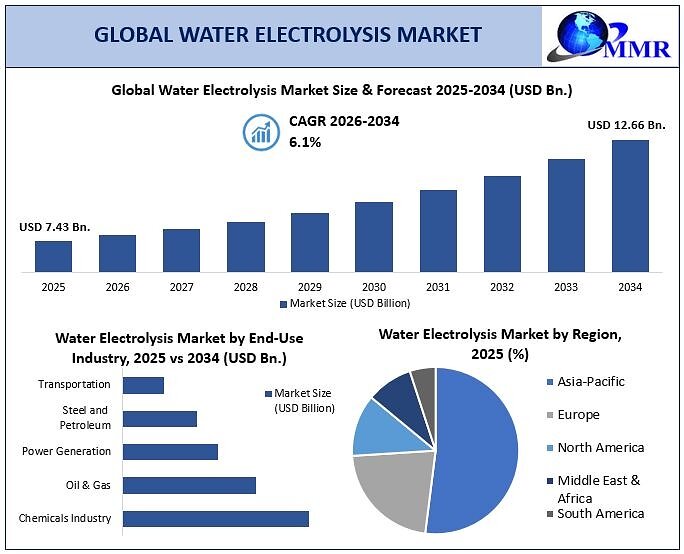
The global market for water electrolysis, a process used to produce hydrogen from water using electricity, is projected to grow significantly, reaching an estimated USD 12.66 billion by 2034. The market was valued at USD 7.43 billion in 2025 and is expected to expand at a compound annual growth rate (CAGR) of 6.1% between 2026 and 2034, according to a report by Maximize Market Research.
Growth is underpinned by increasing demand for low-emissions hydrogen, supportive government policies for clean hydrogen production, declining equipment costs, and a growing pipeline of electrolysis projects. In 2025, global installed electrolysis capacity more than doubled to over 4 GW. While alkaline electrolysis remains the largest technology segment due to its commercial maturity and lower capital requirements, proton exchange membrane (PEM) electrolysis is anticipated to grow at a faster rate, driven by its compact design and compatibility with variable renewable energy sources like solar and wind.
The industry is transitioning from small-scale demonstration projects to larger commercial installations. Key players are focusing on developing and manufacturing cost-effective and scalable electrolysis solutions. Recent collaborations include Nel ASA with Hydrasun, thyssenkrupp nucera with BHEL, and BASF with Siemens Energy. ITM Power has also secured government grants to support manufacturing capabilities. Industrial feedstock remains the leading application segment, with the Asia-Pacific region, particularly China, dominating new electrolysis installations in 2025.
The report indicates that the water electrolysis market is entering a more commercial phase, fueled by the demand for low-emissions hydrogen, integration of renewable energy, and industrial decarbonization efforts. Manufacturers are prioritizing cost reduction, efficiency improvements, enhanced durability, and increased system capacities to meet market needs.